


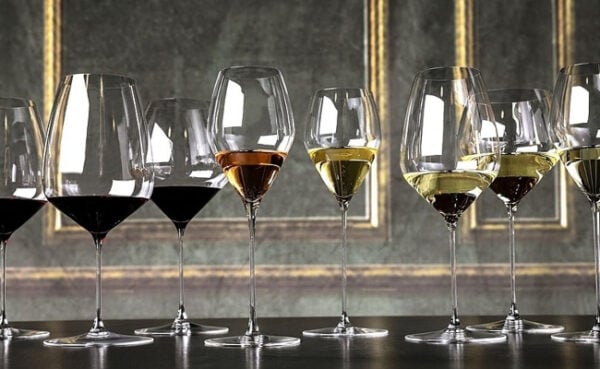
You can pour the finest wines from the world’s best award-winning estates, but something as simple as your choice of glassware can interfere with the integrity of the wine. Poor quality glasses, especially those with thick rims or clumsy shapes, significantly impact on your wine enjoyment. The glass itself can alter aroma delivery, taste perception and even temperature, preventing you from experiencing the full complexity and the nuances that award-winning winemakers work so hard to achieve. The design and shape of the glass direct all wines to specific parts of the tongue and concentrate the aromas. The right glass – like a larger bowl to aerate big reds, or a narrower one for whites to preserve acidity – unlocks the wine’s potential, making glassware quality a crucial factor in tasting.
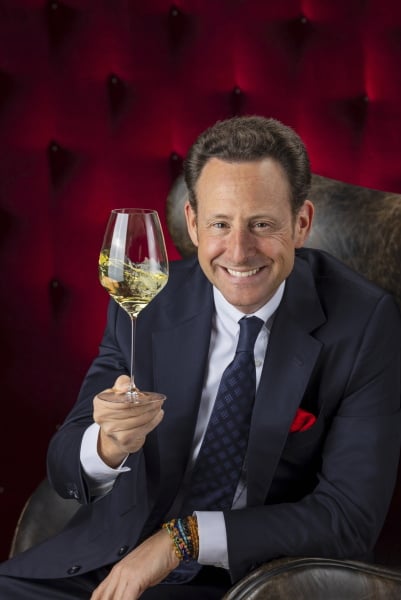
Maximilian J Riedel is the 11th-generation leader of Riedel, having taken over as CEO and president in 2013.
Riedel Crystal, the Austrian family manufacturer, celebrates 270 years of uninterrupted production in 2026. They are currently in their eleventh generation, and are the pioneers of cultivar-specific wine glassware. You might think it is an advertising hoax just to sell glasses. At various recent cultivar-specific wine tastings with the Reciprocal Wine Company, which imports and distributes Riedel glassware in South Africa, we tasted wines from South Africa and France in cultivar-specific glasses – and even the doubting Thomases among us had to admit that they could taste and smell the difference.
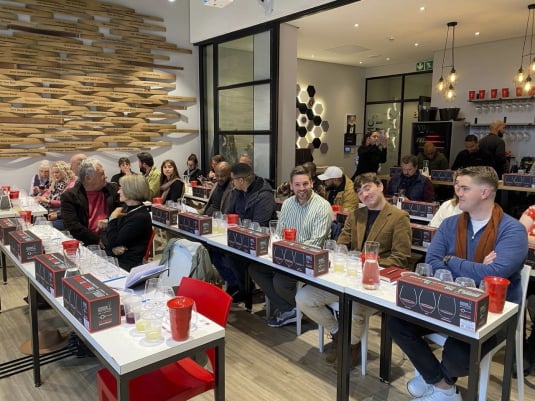
Sommeliers, winemakers and wine sales staff
The first tasting was with sommeliers, winemakers and wine sales staff, hosted at the Cape Wine Academy’s offices in Stellenbosch. The venue was packed as Lauren Kline, export sales manager for Riedel, presented the tasting herself. She travelled all the way from Paris and presented the tasting under “The Key to Wine” banner.
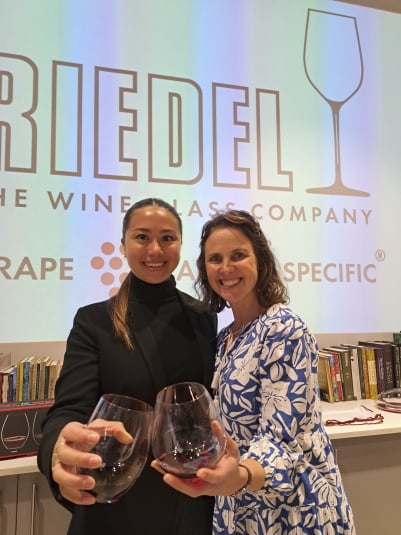
Lauren Kline, export sales manager for Riedel, and Tarryn Vincent from Reciprocal Wine Company
Four wines were tasted in various glasses: the Delaire Graff Coastal Cuveé Sauvignon Blanc 2024, the Boschendal Appellation Elgin Chardonnay 2022, the Creation Pinot Noir 2024, and the Cederberg Cabernet Sauvignon 2022. The tasting sheets were neatly laid out, and our wines were poured into plastic glasses, from which we could decant into the different Riedel glasses.
Lauren says that wine education is not about theory; it is about experience. “The best way to understand wine,” she says, “is to taste it with curiosity and to give it the right conditions to show its personality.” That philosophy lies at the heart of Riedel’s cultivar-specific glassware, a concept that has transformed how wine is evaluated, enjoyed and served around the world.
Riedel is the oldest crystal glass manufacturer still owned and operated by the founding family. Yet, despite this long heritage, Riedel’s most influential contribution to wine culture is distinctly modern: the idea that the shape of a glass directly affects how a wine smells, tastes and feels on the palate. “Our goal has always been simple,” explains Lauren. “We want to improve the wine experience for all wine lovers. The glass is the stage; our job is to let the wine perform.”
One of the core ideas behind Riedel’s approach is that grape varieties behave like people: Each has its own personality. Some are light and delicate; others are bold, structured or spicy. Treating them all the same, Lauren argues, limits what the wine can express. “In markets like South Africa, where so many different grape varieties are produced, it becomes especially important,” she says. “Each cultivar has its own aromatic profile, its own structure and its own balance of acidity, alcohol and tannin. One glass simply cannot do justice to all of them.”
Riedel’s solution is cultivar-specific glassware – wine glasses designed to enhance the best characteristics of a particular grape variety. Rather than focusing on aesthetics first, Riedel prioritises function: how aromas are released, how wine flows onto the palate and how balance is achieved.
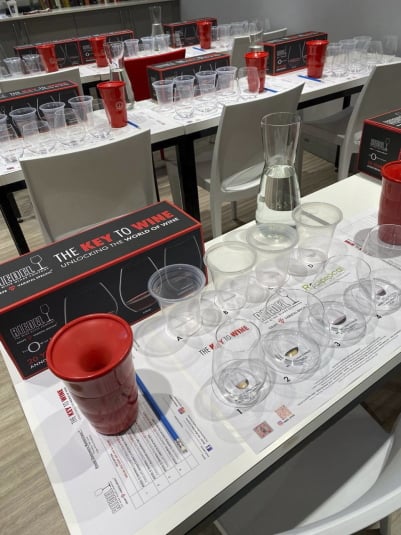
Tasting notes for the four wines at the Cape Wine Academy tasting
Riedel tastings are deliberately comparative. The same wine is tasted from different glass shapes to demonstrate how dramatically shape influences perception. “When you taste the same wine from two different glasses, you don’t just notice subtle changes,” Lauren explains. “You smell different things, you taste different things and the structure of the wine feels completely different.” This method removes abstraction. Instead of being told that glass shape matters, tasters experience it directly – often with surprising results.
Sauvignon blanc provides a clear starting point. Naturally high in acidity, it often displays citrus notes, grassy aromatics and a light body. In a narrow, vertical glass designed specifically for sauvignon blanc, these qualities become focused and expressive. We poured our Delaire Graff Coastal Cuveé Sauvignon Blanc 2024 into the various glasses. Lauren explains: “When the opening is narrow, you naturally tilt your head back slightly. The wine flows directly to the tip of your tongue, where sweetness is perceived first. That helps balance the grape’s natural acidity.”
In contrast, tasting the same sauvignon blanc from a wide chardonnay glass produces a very different result. The wine spreads across the palate, reaching the sides of the tongue, where acidity is most noticeable. The freshness becomes sharp, and the balance is lost. “This grape already has enough acidity,” Lauren says. “We don’t need to emphasise it further. The correct glass brings harmony instead of exaggeration.”
Even more extreme is tasting wine from a plastic cup. With its small surface area and straight sides, aromas fail to collect and concentrate. “You can barely smell anything,” Lauren notes. “For most of history, wine was drunk from goblet-style vessels like this – but we now understand how limiting they are.”
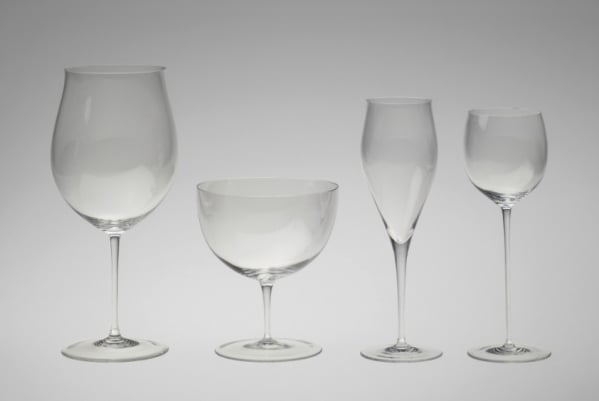
These glasses are now part of the permanent collection at the Museum of Modern Art
The shift away from goblets began in the 1950s with Claus Josef Riedel, the ninth generation of the family. Influenced by the Bauhaus movement – which emphasised function before form – he set out to create a wine glass designed purely for performance. “He closed the top of the glass, creating what we now recognise as an egg shape,” says Lauren. “That was revolutionary at the time and technically very difficult to produce.” By experimenting with different shapes, Claus Riedel discovered that glass geometry had a profound effect on aroma and flavour perception. This insight led to the creation of the first modern wine glass – now part of the permanent collection at the Museum of Modern Art (MoMA) in New York, in the Architecture and Design section. “Almost every wine glass you see today is, in some way, a copy of that original Riedel design,” Lauren adds.
Oak-aged chardonnay highlights another important principle: the need for space. These wines are often richer, creamier and lower in acidity than sauvignon blanc. “In a small white wine glass, chardonnay becomes heavy and cloying,” Lauren explains. “You lose the taste the spice and the buttered notes that make the wine interesting.” A larger chardonnay glass, with a wide bowl and a generous opening, allows the wine to spread across the palate, emphasising acidity and restoring balance. Aromas intensify, textures soften and the wine feels more complete. “What’s remarkable,” Lauren notes, “is that even one drop of wine left in the correct glass smells more complex than a full pour in the wrong one.”
One of Riedel’s most popular innovations is the O Collection, a range of stemless, varietal-specific glasses. Initially controversial, it has become a global bestseller. “The idea came from Maximilian Riedel when he was living in New York,” Lauren explains. “People loved the glasses, but didn’t have space for them. Dishwashers were small; cabinets were tight.” By removing the stem but preserving the bowl shape, Riedel maintained performance while improving practicality. “The bowl is what matters most for tasting,” she explains.
“The stemless design gives ease without sacrificing experience.
“At a picnic, on a patio or in a casual setting, the temperature difference is negligible compared with outdoor conditions. It’s always a compromise between environment and experience.”
With red wine, tannin introduces an entirely new dimension. Thin-skinned grapes like pinot noir behave very differently from thick-skinned varieties such as cabernet sauvignon. “Pinot noir is light, delicate and elegant,” Lauren says. “It needs a wide bowl but a narrower opening to release aromas while concentrating them.” In the correct pinot noir glass, red berry fruit, freshness and fine tannins are beautifully balanced. But when poured into a cabernet glass, the same wine becomes harsh and astringent. We experience it first-hand with the Creation Pinot Noir. “People blame the wine,” she observes. “They think it’s bitter or poorly made. Nobody thinks to blame the glass.”
Cabernet sauvignon, on the other hand, thrives in a taller, more structured glass that softens tannins and highlights darker fruit. In a pinot noir glass, it becomes aggressive and unbalanced. “These aren’t subtle differences,” Lauren says. “They completely change the wine.”
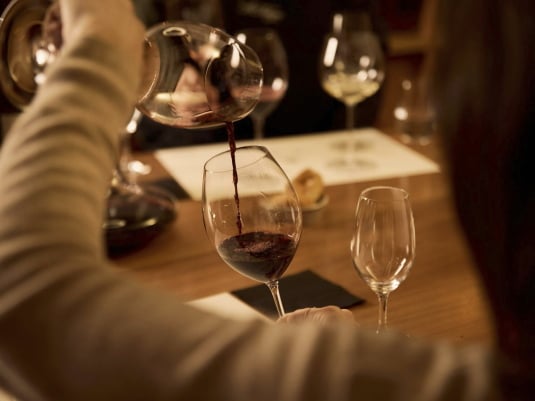
Guests pour wines between glasses to experience the difference the glassware makes.
One of the most revealing moments in comparative tastings comes when pinot noir is poured into small tasting glasses commonly used at trade events. “It turns into something thin, bitter and uninteresting,” Lauren explains. “People then decide they don’t like pinot noir, when in reality they’ve never experienced it properly.” This, she believes, has shaped global misconceptions about certain grape varieties. “The glass can make or break the reputation of a wine.”
Riedel’s design process is deeply collaborative and empirical. Winemakers, glassmakers and the Riedel family taste together, comparing dozens of shapes. Lauren reports: “We don’t start with a drawing. We start with tasting. Shapes are eliminated one by one until the best expression of the wine remains.”
As climate change alters grape composition – higher sugar, lower acidity – glass shapes evolve. “You’ll notice that newer glasses are often larger,” Lauren explains. “They reflect what’s happening in vineyards today.”
Ultimately, cultivar-specific glassware is about respect – for the wine, the winemaker and the person drinking it. “Why go to a museum and look at a masterpiece with one eye closed? Wine is meant to be enjoyed fully. The glass is the lens that lets you see the whole picture,” Lauren says.
We each receive a three-glass set of the O Collection to take home to experiment with wines in our own collection. It is quite handy for keeping in your car and using when going wine tasting on wine farms.
Our next opportunity to put the Riedel cultivar-specific glassware to the test was at the Belgian Beer and Barrel Festival, held at the Belgian Residence in Cape Town. Tarryn Vincent from the Reciprocal Wine Company, who imports Riedel into South Africa, hosted the tasting. On offer were the Lemahieu Family Range Lodewijk Wood White Blend, Chardonnay and Viognier; the Almenkerk Chardonnay; the Ameera Envie (Sauvignon Blanc); the Redamancy Cabernet Sauvignon; the Spioenkop Pinot Noir; and the Tempel Wines Oogwink Shiraz. They were first tasted in a normal tasting glass like those found at every tasting room across the globe, and then in the correct cultivar-specific glass. The difference took even the most sceptical among us by surprise. Tarryn explains: “Cultivar-specific wine glasses are important because their precise shapes are designed to enhance the characteristics of a particular wine by controlling its aroma and how it hits the palate. The design of a glass concentrates volatile aromatic compounds, channels them to your nose and determines the amount of aeration, allowing you to experience the wine’s complex flavours and textures more fully, creating a more balanced and elevated tasting experience.” Read the full article on the occasion here: https://voertaal.nu/belgie-bo/.
A few weeks later, we did a tasting at Bacco Estate Winery on the outskirts of Paarl: “Understanding Burgundy – North to South, Top to Bottom”, with Marine Point, export manager of Maison Louis Latour, a French wine estate famous for its pinot noir and the largest collection of grand cru vineyards in Burgundy. In an informal walk-around tasting of red and white burgundies hosted by Marine, Bruno Pepin (commercial director of Louis Latour) and Tarryn Vincent (Reciprocal Wine Company), the glassware really shines.
Eleven wines are available to taste: Louis Latour Bourgogne Aligoté 2021, Louis Latour Grand Ardèche Chardonnay 2022, Louis Latour Pouilly Vinzelles “En Paradis” 2021, Louis Latour Meursault Blanc 2020, Louis Latour Chassagne Montrachet 2022, Louis Latour Valmoissine Pinot Noir 2022, Louis Latour Marsannay Rouge 2020, Louis Latour Côtes de Beaune-Villages 2020, Louis Latour Pernand-Vergelesses “Ile de Vergelesses” 1er Cru 2019, Louis Latour Nuits-Saint-Georges 2020 and Louis Latour Corton “Clos de la Vigne au Saint” Grand Cru 2020.
Ultimately, the tastings proved to us that wine is not just about the grape, the vineyard or even the winemaker. It is also about the vessel in which it is enjoyed. The right glass enhances aroma, balances flavour and reveals the personality of each wine, turning a simple pour into a full sensory experience.
- Photos: Clifford Roberts and supplied
See also:
Storie van Pinotage is vervleg met vriendskap en pioniersgees
Various milestones celebrated at Stellenbosch’s Meerlust Wine Estate
