


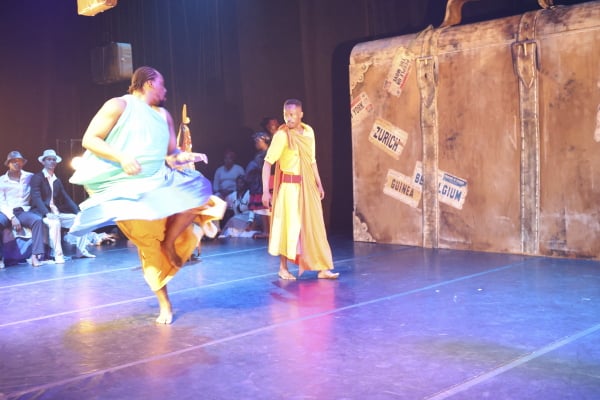
To leave everything you know behind, is to undergo a violent loss of the self. It means stripping away the physical anchors of your existence: the threshold of your childhood home, the specific slant of morning light through a familiar window, the sound of your neighbour’s voice, and the very soil that holds your ancestry. It is an act of profound loss, where security, status and identity are instantly traded for the gruelling currency of survival.
Yet humans are never entirely emptied by flight. When you leave, you carry an invisible, heavy suitcase: the rhythm of your mother tongue, the muscle memory of your culture’s dances, the haunting ghosts of unpunished injustices, and the unyielding embers of hope. You carry the trauma of what was lost, but also the blueprint of how to rebuild.
Today, the world watches this rupture happen at a devastating, unprecedented scale. During global observances – such as International Migrants Day (18 December) and World Refugee Day (20 June) – the international community is called upon to reflect on human mobility and forced displacement.
Yet we live in an era where global systems do not merely witness migration; they actively demand it. Through the slow violence of climate collapse, the sudden brutality of manufactured wars, and the crushing weight of systemic economic exclusion, millions are forcefully dislodged from their geographies.
The tragedy of the modern world is not just that people are forced to move, but how they are received when they arrive. The global stage has grown chillingly hostile. Borders have been weaponised into lethal barriers, bureaucracy has been engineered to strip away human dignity, and public discourse frequently reduces human lives to threatening statistics or political leverage.
Human beings fleeing catastrophe are increasingly treated not as victims of global crises, but as the crisis itself – their bodies policed, their identities criminalised, and their right to belong continuously denied. It is against this backdrop of forced displacement and systemic hostility that artistic resistance becomes vital.
When global institutions fail to uphold humanity, contemporary art and physical theatre step into the breach. By bringing the invisible weight of the migrant’s baggage onto the stage, creators refuse to let the global conscience look away. They transform cold geopolitical statistics back into flesh, blood, memory and undeniable human dignity.
This urgency lies at the heart of the latest production by SboNdaba Dance, a Cape Town-based non-profit company committed to creating professional opportunities for talented artists from under-resourced communities, and bringing the transformative power of dance to audiences across South Africa. The organisation was founded to create employment, provide professional training and build up artistic platforms for talented youth from under-resourced township communities across the Western Cape (such as Khayelitsha, Gugulethu, Langa and Philippi). The company operates out of an old, repurposed Methodist church in Observatory, Cape Town.
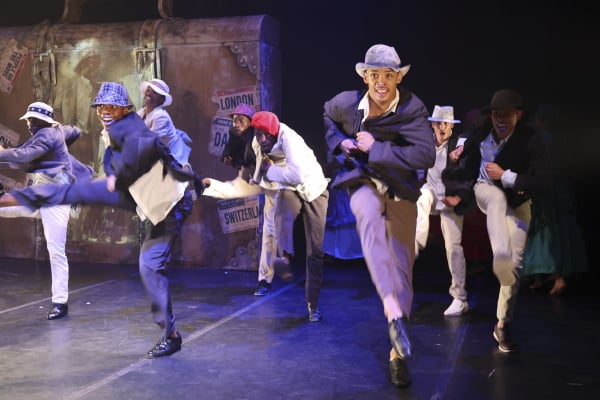
Led by award-winning choreographer and artistic director Sbonakaliso Ndaba, alongside Jennifer van Papendorp (managing director) and Paula Kelly (operations director), the company creates bold and thought-provoking performances that draw on South Africa's rich cultural heritage, while engaging with contemporary social and global issues. The name itself is a portmanteau derived directly from Sbonakaliso “Sbo” Ndaba.
SboNdaba Dance celebrated their fifth anniversary with the premiere of their new show, People on the move, at the Toyota Stellenbosch Woordfees earlier this month, where the stories of exile, migration and belonging were told through the powerful language of dance. The dance group are no strangers to this town, known for its oak-lined streets and its arts festival held every year since 2000. SboNdaba Dance was honoured with the Woordfees 2025 In Solidarity Award, with the citation recognising the company for reminding audiences of “the transformative power of dance to challenge, uplift and unite”. SboNdaba Dance joins a distinguished legacy of past recipients, including Simon Witbooi (HemelBesem, 2017), Janine Neethling (2018), Felicia Lesch (2019), Amelda Brand (2020), Lee-Ann van Rooi (2022), Frazer Barry (2023) and Rudolf Gouws (2024).
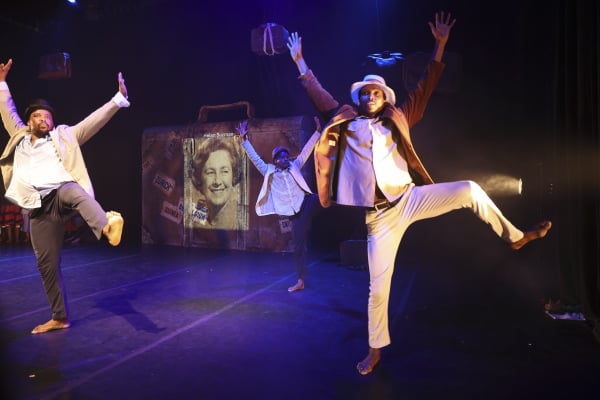
Sbo’s artistic legacy is deeply rooted in South African dance history. Growing up in Durban, she began dancing at age eight, famously turning her mother's kitchen into a studio. By 17, she was performing as a singer and dancer in Mbongeni Ngema’s iconic Sarafina!, later training professionally at the Jazzart Dance Theatre. Over a career spanning more than 30 years, she has choreographed for television (including Backstage and Big brother) and cofounded foundational training institutions, such as the Phenduka Dance Theatre and the Indoni Dance Arts Academy.
Her lifelong commitment to grassroots activism and artistic excellence was recognised when she was named a JOMBA! Legacy Artist at the 27th annual JOMBA! Contemporary Dance Experience at the University of KwaZulu-Natal. As part of this honour, SboNdaba Dance performed her piece In search of our humanity, featuring 12 dancers and exploring identity, historical displacement and ubuntu, at the Sneddon Theatre in Durban and the Market Theatre in Johannesburg. As Sbo explains: “From professional theatre stages and festivals to schools and community spaces, we believe dance belongs everywhere. Through performances, workshops and outreach programmes, the company uses movement, music and storytelling to create meaningful connections, open conversations and celebrate our shared humanity.”
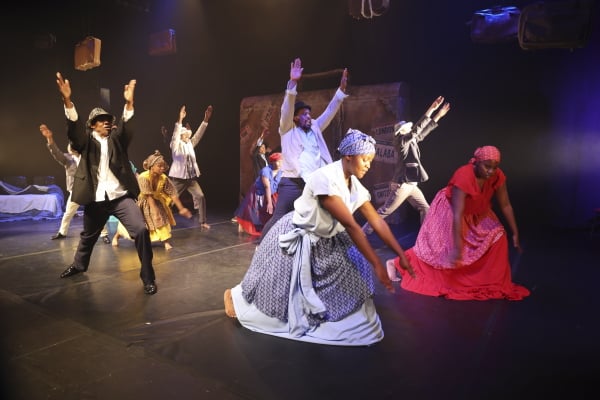
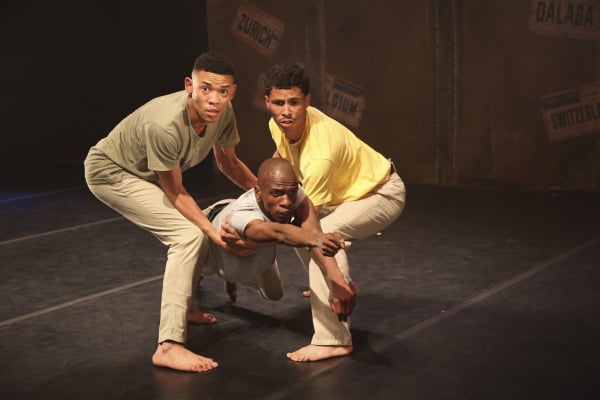
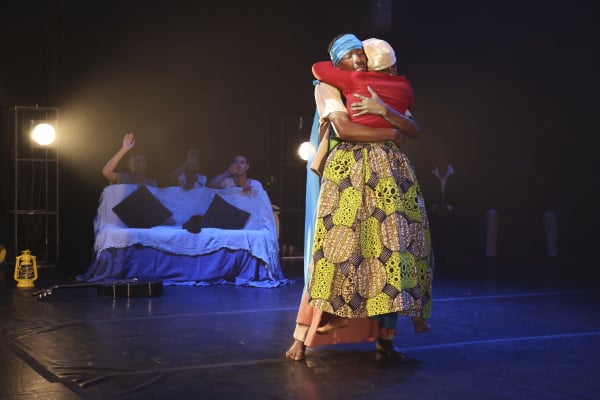
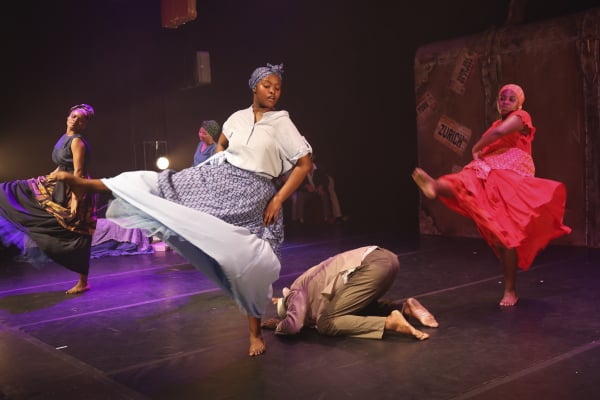
People on the move explores the deeply human experiences of departure, exile and the search for home. Inspired by the journeys of political activists, musicians, scholars, writers and ordinary individuals, the performance reflects on the courage required to abandon one life in pursuit of another.
At the core of the staging is the suitcase – a simple yet potent symbol of movement and memory carrying loss, resilience, identity and possibility. Under Sbo's direction and choreography, with set design and construction by Leopold Senekal and vibrant traditional costuming by Jenny Stretch, theatrical imagery works alongside movement to question what remains with us when we leave, and who we become along the way.
The production’s musical score directly links personal narrative to South Africa’s history of forced displacement and artistic resistance. Anchoring the piece are compositions by three legendary South African icons who lived and created in exile during apartheid: Miriam Makeba (whose song “Suliram” is played), Hugh Masekela (the song “Stimela”) and Abdullah Ibrahim (the songs “Cape Town” and “The wedding”). The music connects the personal stories within People on the move to South Africa's history of displacement, resistance and cultural expression beyond its borders. These foundational anti-apartheid works frame the journey on stage, evoking the emotional landscape of exile – such as transporting the audience to the streets of Manhattan, where a lead character attempts to resettle and start anew while grappling with the lingering ghosts of the family and life left behind. The main historical score is supported by an eclectic selection of complementary atmospheric soundscapes and instrumental tracks: “Ancient ubuntu voices” by the Deep Healing African Choir for Inner Peace and Relaxation, “In my stripes I shall be known” by Deep Relaxing Music, “Play me” by Gene Ammons, “Alone in a strange place” by Sipho Gumede, “Sondela” by Dudu Pukwana and “Deeply emotional blues” by Guitar48.
The performance of People on the move inside the Adam Small Laboratorium – the black-box experimental theatre within the Adam Small Theatre Complex at Stellenbosch University – carries profound symbolic weight. The connection extends far beyond a standard venue booking; it is an intersection of shared history, philosophy and spatial intimacy. The university renamed the HB Thom complex after Adam Small, the celebrated writer and philosopher whose literary work challenged apartheid and elevated the voices of marginalised communities, as an explicit act of redress, recognition and reconciliation. Staging a production focused on migration and political exile – underscored by the music of exiled anti-apartheid icons – inside a space dedicated to Small’s legacy creates a powerful resonance of artistic resistance.
Furthermore, the physical structure of the experimental black-box laboratory plays a crucial role. For a high-energy, visceral company like SboNdaba Dance, stripping away the traditional proscenium stage removes the barrier between performer and viewer. It confronts the audience, especially those in the front row seats who have their feet on the stage. The spectacle transforms into an immediate, emotional encounter, forcing the audience to meet the lived realities of township artists, historical exiles and modern refugees up close.
- People on the move will return to the stage at the Artscape Arena in Cape Town on 2–5 December 2026. The team says they look forward to sharing this work with new audiences and continuing the conversation about migration, belonging, displacement and our shared humanity.
Book at https://www.webtickets.co.za/v2/event.aspx?itemid=1605394579.
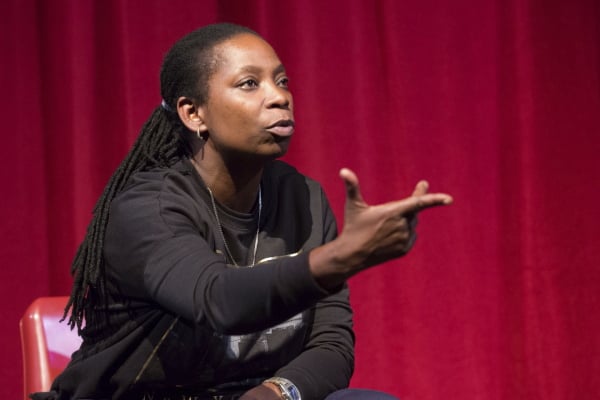
Sbo Ndaba
Questions for Sbonakaliso Ndaba:
In a South Africa still grappling with systemic economic exclusion and anti-immigrant tension, how does today’s sociopolitical reality shape your choreography?
People on the move was driven by how I felt South Africa was beginning to breathe. The air around us as a nation no longer seemed to be giving life; instead, it felt as though it was destroying some lives.
We have carefully embraced and removed some of the stigmas that led to the oppression of people and created fractures in our society. South Africa should not entertain anything that excludes others. We need to ask ourselves: Who can be forcibly moved? How are people allowed to travel, and where can they find a place to rest?
That is why I created this particular work. Through movement, I wanted to say that South Africa is for everyone. If we are genuinely interested in the well-being of others, we must demonstrate that commitment all the time, not only when an election is approaching. South Africa is a big country, and we can afford to include immigrants. There is room for all of us.
How does People on the move speak directly to modern South Africans, rather than treating displacement as a historical or distant crisis?
It speaks to modern South Africa through a simple message: Honour and treasure your fellow citizens. Home is where you belong. Trust one another and dream of a peaceful country. Imagine yourself lifting someone up rather than bringing them down. We need to erase the idea that life is a competition with others. There is no big or small person. We all matter.
Judge not. Instead, cherish the time you spend with another person, because we are all pieces of a puzzle, made to fit together. Throw away your boxing gloves. We need to learn to live alongside one another, rather than fight one another.
You anchor the production in works by anti-apartheid icons who lived in exile, including Miriam Makeba, Hugh Masekela and Abdullah Ibrahim. More than 30 years after apartheid ended, why must contemporary dance revisit these specific voices, and what do they reveal about the emotional baggage South Africans still carry today?
I anchored the production in the work of anti-apartheid icons who lived in exile because I wanted to honour them. It comes from a place of pure love and respect for these artists. They reshaped our country's musical culture. When they returned home, South Africa took notice of them, initially as celebrities. By then, their stories were no longer seen as the threat they had once mistakenly been perceived to be. They brought home an international flavour through their music. I don't think that we, as an industry, have brought these icons together through dance and truly told their stories in this way. That was something I wanted to explore.
Since apartheid ended, the gates have opened to greater international exchange. We have relationships with global markets through investment, imports and exports, and many other forms of engagement. Yet we must also remember the human stories behind our history and the journeys people have taken to get where they are today.
Water is water, even if you don't call it anything. It still moves quietly. For me, this is a reminder that some things continue beneath the surface, even when we do not acknowledge them openly. Something beautiful has emerged from our history, and we need to be careful with one another and protect it.
Contemporary African dance belongs to the present. It speaks to every day that we live. I specialise in this form because it allows itself to be defined as African dance, while remaining flexible enough to take on the shape of contemporary dance. That flexibility allows us to tell our stories in ways that speak to the world today.
Performing inside a space dedicated to Adam Small’s legacy of redress, where front-row audience members have their feet directly on the stage, carries immense weight. How did this intimate black-box space alter the energy of the performance and force the audience to confront the reality on stage?
What an honour it was to premiere my work in that space. To me, that meant something big. First, I must thank Sir Adam Small. I have enormous respect for this South African playwright, poet, philosopher and anti-apartheid activist. If he were still alive, I believe he would have loved the cast and the story of the people he fought for and wrote about. He completed his journey victoriously.
The black-box space demanded that the audience pay close attention to every moment, every movement and every detail of the spoken text. They received the story first-hand, with nothing to distance them from what was happening on stage. The audience members seated at the front were so close that they almost became part of the dance themselves. As the cast paid tribute to those who played a role in liberating black people from oppression, I believe the spirit of Sir Adam Small was present. It seemed to strengthen my dancers and inspire them to move with the extraordinary power they brought to the performance.
From performing in Sarafina! as a teenager to leading SboNdaba Dance today, you have had a career spanning more than three decades of activism. How has your personal understanding of “art as resistance” evolved over time? Have the battles changed, or are they fundamentally the same?
A huge change has taken place over the years. I remember the song I used to sing whenever I thought about what was happening: “Safasaphel’ Sizwe Simnyama”, which I sang in the film Sarafina!. Today, I view art as a promise of life and hope for a better future.
I have noticed a change in how audiences respond to our work. Sometimes, audience members think that artists should create provocative art simply for the sake of provocation. I want people to look at art as a library or a museum, a place where knowledge is preserved, stories are explored and understanding can be achieved. This is how I choose to tell some of our South African stories. People are slowly beginning to understand the history that has remained hidden behind closed windows. True stories interest me. Our country is full of history waiting to be told, so let us not ignore it. Whether the stories are sweet, sour or bitter, as long as they are part of the South African dish, we must serve them.
I love Steve Biko's definition of Black Consciousness as an attitude of mind and a way of life. It speaks to the importance of how we think, how we see ourselves and how we engage with the world. I believe the battle is slowly moving towards the positive side of things, although some ideas still resist change. We have made progress, but there is still work to do.
The piece centres on the “invisible suitcase” of memory, loss and hope that migrants carry. Working with young dancers from under-resourced township communities such as Khayelitsha and Gugulethu, how do you guide them to translate these heavy, abstract themes into raw physical movement?
Everyone carries an invisible suitcase. It is where we keep our emotions – our psychological struggles, our stress and the physical emotions we carry and sometimes lock away inside ourselves. For migrants, that suitcase also carries memories, loss and hope. They must continue to hope that things will eventually work out for them. I remember Nelson Mandela speaking about the importance of looking after migrants and those who come to South Africa seeking refuge.
Being born in South Africa means that you become a walking story, or a storyteller, yourself. Our dancers come from townships across Cape Town, and they, too, carry stories shaped by their experiences and surroundings. When preparing the dancers for People on the move, I used Google to research facts and gather information about the artists whose music inspired the production. I told the dancers many stories, because I knew these artists, and the dancers knew their music, too.
Sometimes we take things for granted. If you do not explore a person’s entire life story, you may focus only on their music and miss a huge part of their lives, including their family experiences and personal struggles. We therefore went deeper into their stories to understand the people behind the music.
I gave the main characters more information and detail, and with some of the younger dancers, I had to explore the different layers of these stories more deeply. They do not necessarily hear this kind of music today. It is rarely played on social media, and I hardly hear it on the radio. Young people are taking in so much information all the time. There is a constant pressure to buy, buy, buy and create content. I wanted my dancers to look beyond that – to listen, learn and understand the histories behind the music. By giving them this knowledge and context, I helped them connect with the stories emotionally and physically. Their movement could then come from a deeper understanding of the people, their journeys and the invisible suitcases they carried.
