


Postumities for Breyten [Postumiteiten voor Breyten] is the title of a series of written conversations devoted to the literary legacy of Breyten Breytenbach (1939–2024) and his impact on the work of contemporary poets writing in Afrikaans, English and Dutch, as well as on translators.
On 24 November 2026, two years after Breytenbach’s death, the volume Postumities for Breyten will be published in the Netherlands and Dutch-speaking Belgium, as well as in South Africa (Skribis/Naledi). It brings together conversations with poets, as well as with writers who have translated Breytenbach’s work. The commemorative volume will be presented on the eve of the international symposium ‘Inter-Breyten. Breytenbach in Context’ (26-27 November 2026, Ghent University: more information).

The second part of the commemorative volume is devoted to conversations with scholars specialising in Breytenbach. These contributions have likewise been published in advance on Voertaal.
The introductory text presenting the project and outlining the concept behind the conversations on Breytenbach’s literary legacy can be found here: introduction to the project.
In total, thirty poets and translators have contributed, alongside nine scholarly researchers. All poets and translators were asked the same five questions about the ways in which Breytenbach’s work has informed and shaped their own writing and translation practices.
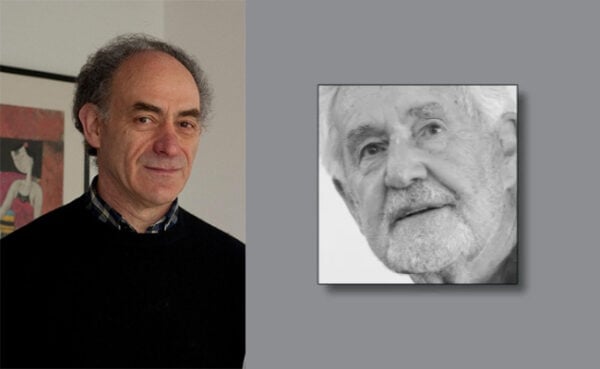
In this interview, Denis Hirson, Breytenbach’s English translator, is in conversation.
...
I was also translating the work of a man who was in the same jail where my father had spent nine years as a political prisoner, and when during that time I sent him my poems they were thickly blacked out by the Afrikaans-speaking prison censor.
...
YT: Is there a particular collection, or perhaps a distinct aesthetic period, within Breytenbach’s poetic oeuvre that has a special place in your heart, and if so, why? The poet brought his previously published collections together in three substantial volumes: Ysterkoei-blues. Versamelde gedigte 1964–1975, Die ongedanste dans. Gevangenisgedigte 1975–1983, and Die singende hand. Versamelde gedigte 1984–2014. Which Breytenbach has been most significant to you in your own development as a writer—and, above all, as a translator of his work? Do you find yourself drawn more to the early poetry, or to what might be called his ‘late style’? Would you identify a particular literary influence: a moment, perhaps, or even a single poem, that in some way helped shape your own writing and, by extension, your work as a translator? And could you give us a sense of the place Breytenbach’s work has occupied in your translation career?
DH: Die ysterkoei moet sweet was the first of Breyten’s books which I ploughed through, with considerable difficulty, given my reading level in Afrikaans at the time, in the late 1970s. About thirty years later, I devoted a quarter of my book White Scars to this volume, and came to see at least one reason why, despite my initial only partial comprehension of the text, it had reached into me: I believe that the opening section is not only preoccupied with death, but with a personal rite of passage of one who has left his country behind and mourns it, at the same time finding himself in a strange, inhospitable no-man’s land. The second section involves the inner transformation this condition leads to, while in the third his counterpoint to despair is intimacy, the presence in his life of Yolande, “a delicate flower of pulsing ivory” (in ‘Nagmaal’). Apart from the fact that this kind of imagery appealed to me when I first read the book, I myself was going through stages similar to those of Breyten as, in confusion, I entered the barely decipherable world of France. Perhaps this is at least one reason why the poems attracted me.
It is difficult to know to what extent if at all the content of Breyten’s work has fuelled my writing. But the act of immersing myself in his particular Afrikaans, so very different from the thickly twisted barbed wire language of apartheid, was surely of great importance to me.
YT: Alongside the explicitly political and socially critical poems, there are those in which Africa emerges through the imagination; the many love poems; the poetry haunted by decay, putrefaction and death; the nomadic discourse of the Middle World; and the Zen Buddhist poems. Is there a particular dimension of Breytenbach’s poetry that you have read with a special sense of affinity or fascination?
DH: I return to some of Breyten’s love poems with pleasure. Not so much those in which he uses his pen as a brush, painting a seductive, surreal picture of a woman, or depicting her various physical parts. I now prefer those, such as ‘hoe vaak was ons hier tussen koeltes op die vloer’, in Skryt, in which he is able to more fully evoke a relationship (not always an easy one) and render himself vulnerable: “and then I wished you could have laughed / and your bitter body / my hands of porcelain on your hips / your breath such a dark ache / a sword at my ear / how often were we here / where only silver shadows are left stirring”. Likewise, some of his prison poems continue to move me, as he gathers his stamina in order to maintain his humanity. A poem such as ‘jou brief’, in Voetskrif, threads these two vital themes together.
On another tack, one of my favourite poems by Breyten was neither written in prison nor is it a love poem, it is ‘Ek is bevrees ek verlang aldag meer na ’n eenwording’ in Lotus, and explores Breyten’s not unambiguous relationship with the spiritual world. He evokes “a god who reeks of sperm and garlic, who / crashes through mountains and waters, fallible and cruel and / human and hideous / exquisite as a pomegranate tree / in the silver night”.
YT: Breytenbach expressed himself in both reflective prose and poetry. He also delivered public speeches and wrote Notes from the Middle World, as well as the trilogy comprising ’n Seisoen in die paradys, The True Confessions of an Albino Terrorist, and Return to Paradise. The various literary forms through which he gave voice to his ideas and created such a richly imaginative universe are inseparably intertwined—a quality that can equally be seen in his paintings and drawings. Which of his texts continue to move or inspire you today? And are there particular works to which you return in your memory because of a memorable or formative reading experience?
DH: ’n Seisoen in die paradys is my favourite work by Breyten. It is beautifully lyrical, shifting easily between prose and poetry; filled with the emotion of returning to South Africa, the difficulty of confronting the political situation there, the love he bears Yolande, his playful humour, the fresh, combative audacity of the ‘blik van buite’ speech. This speech itself is memorable, as are a number of other sections, such as the one where Breyten absorbs the Afrikaans being spoken in the streets of Onrus after being away in Paris for so long: “the room is filled with deliciousness and the roar of the waters, and outside the voices of my people hum; our people, carrying, cradling us with their voices.” And then there is the tale of the master-fiddler of the Cederberg who “placed his wife’s corpse across his knees and took out his fiddle and right through the night he played while the predators sat around him with gleaming eyes, listening. Then, with the youthful light of the new day […] he carried her from the gorge, unscathed, and down the mountain, away from the place of death where the medicine smells so sweetly.”
As I cite this passage I still see the seasoned actor Marcel van Heerden trembling while reading it aloud in Afrikaans at the Market Theatre in Johannesburg. It is 16th September 1983, Breyten’s birthday, we have chosen this passage plus poems from In Africa Even the Flies are Happy to read together in English and Afrikaans, Breyten has been out of prison for less than a year and the emotion, if not almost the taboo, of presenting his work in public in South Africa, still swirls around us.
YT: How did you first encounter Breytenbach’s work? What do you remember of that first encounter, and has your sense of him or of his work changed as your reading journey unfolded? What significance do you think Breytenbach has had for Afrikaans, the language he himself called a ‘bastard language’—a Creole language, but above all a language of Africa?
DH: In 1976, a bit more than a year after my arrival in France, I was working as an actor at the Cartoucherie de Vincennes outside Paris, and went to tell a man that he should not park his car on the delicate lawn. The man laughed at my French accent, wanted to know where I was from, then asked if I would read the work of two South African poets at a “festival of the oppressed” that would soon be taking place in what was then the old train station at the Bastille. One of those poets was Oswald Mtshali, and that was easy enough because I knew his work, and it was written in English. The other poet was Breyten Breytenbach, who had not so long previously been arrested in South Africa. I told the man I would read Breyten’s poems, in Afrikaans as he requested. What I did not tell him was that, while I thought I could perhaps render something of the song of the language, I would have been incapable of deciphering what I was reading (I had been lucky enough to get an “E”, the lowest possible pass mark, for Afrikaans in matric, the South African baccalaureate). So I hurriedly hunted down Georges Lory, who was at the time translating into French the poems by Breyten that would make up his book Feu froid. My French was just about good enough for me to be able to choose a few of them, understand more or less what I was reading on the stage during the festival, alongside artists from Algeria, Vietnam and elsewhere.
YT: Could you capture, in a few sentences the boundary-breaking—and even iconic—significance of the poet Breytenbach? You are among the translators who have helped bring his work to readers in the English-speaking world. How, then, would you introduce Breytenbach’s poetry to future readers—in South Africa and elsewhere? What would you say to make them want to enter his poetic world?
DH: I would strongly suggest they begin by reading A Season in Paradise.
As for the question of boundary-breaking, it was for me to begin with quite personal. Like many white English-speaking South Africans, while still living in South Africa I spoke only my mother tongue, finding myself unable for different reasons to engage with any African language or Afrikaans. In translating Breyten’s work I was, among other things, crossing a heavy old linguistic buffer zone inside myself. I was also translating the work of a man who was in the same jail where my father had spent nine years as a political prisoner, and when during that time I sent him my poems they were thickly blacked out by the Afrikaans-speaking prison censor.
Many years after publishing In Africa Even the Flies are Happy, during the wave of change following Nelson Mandela’s release, I edited several anthologies of South African writing, including The Lava of This Land. South Africa Poetry 1960-1996, in which I broke both the boundaries of race and language, including work in several African languages and Afrikaans, with Breyten’s work well represented. I believe that having translated his poems all those years earlier was a partial preparation for this enterprise.
See also:
Breyten schrijven #49: Gesprek met Georges Lory, de Franse vertaler van Breyten Breytenbach
