


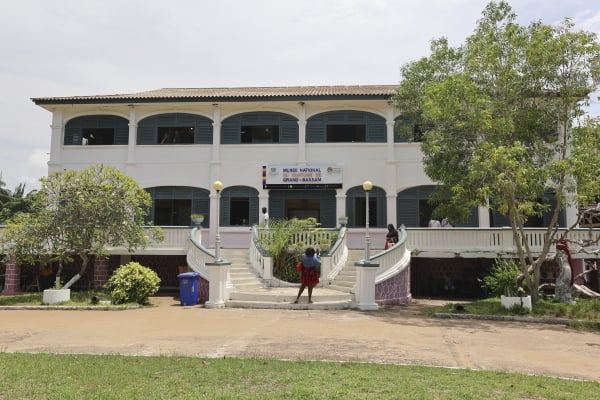
The National Museum of Attire in Grand-Bassam celebrated a milestone birthday in recent weeks.
The evolving of societies means that all museums constantly pursue ways to stay relevant. In West Africa, one such entity has been thrust into the spotlight due to a decade-long economic boom that has brought a flood of expats to its shores.
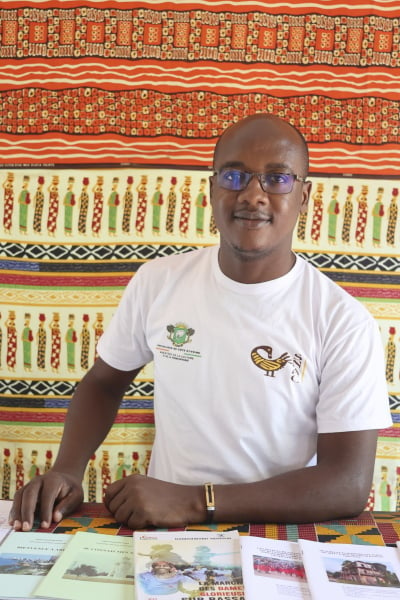
Museologist Ghislain Teya
It’s mid-morning at the National Museum of Attire in Grand-Bassam, Ivory Coast, and several streams of children from a visiting high school are being channelled towards their designated guides. Museologist Ghislain Teya’s day is about to get a lot busier. He eyes the sudden queue before wrapping up his introduction to me. The museum was established some 20 years after the end of colonial French rule, he says. More than a collection of display cases, the institution was created first and foremost to serve as a cultural beacon for Ivorians themselves. This year, on 30 April, marks its 45th birthday.
In the first room, I encounter a group of teens who swarm around the guide as he contextualises framed black and white photographs from the colonial era: a white man in a hammock, slung between two black porters; a group of uniformed Ivorians waiting to board a ship on their way to fight Nazi Germans in Europe; and more. Mobile phones are raised and sway like poppies in a field, recording his every word.
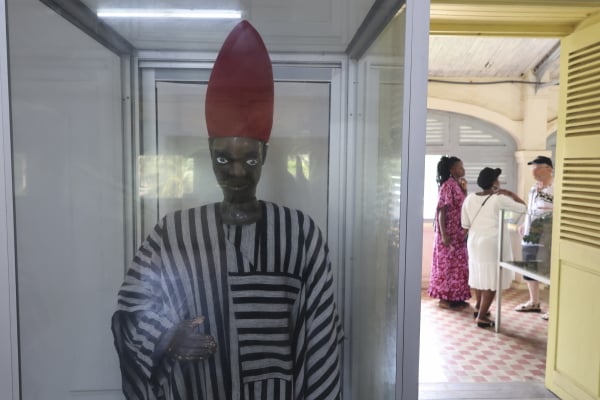
Attire on show includes ceremonial and royal garments.
It’s a sight to behold, considering that Ivory Coast gained its independence in August 1960, after some 80 years of French rule. Many teens might consider this ancient history, but intriguingly, places such as the costume museum have resurged in recent years. The original intent with its establishment was to be an important part of reclaiming a national identity. In recent years, however, new cultures have flooded into the Francophone country of West Africa and returned the concept to prominence.
Ivory Coast has always been a rich source of products like cocoa, mineral fuels and oils, gold and other precious metals, natural rubber, fruit and nuts. Its history has also been peppered with the typical tumult that plagues most former colonies. Since 2012, however, societal stability has spurred it to become one of the strongest economic performers on the continent and in the world.
The melting pot of cultures that has long been a feature of Ivorian society has intensified as foreign companies plough investment – and their representatives – into the region. In Abidjan, the financial capital of the country, there are business chambers for Switzerland, Canada, South Africa, the US and others. Belgium is a key partner in the construction of Tour F, the completion of which will soon make the building the tallest in Africa and potentially 8th in the world. Down below on the streets are West African nationals and French citizens, but also Lebanese, Chinese, Koreans and more. Getting to the country has also become even easier with, for example, Ethiopian Airlines having significantly solidified its presence in the country and transformed Abidjan into a critical node for its West African operations.
It is a new kind of tumult. Already familiar with upheaval, leaders in the 1980s had implemented ways that might help to unify the country. The duty of reminding Ivorians of their history, culture and traditions was essential for the country’s first president, Félix Houphouët-Boigny, who died in 1993. Under his purview, the museum opened in the former capital of the French colonial enterprise.
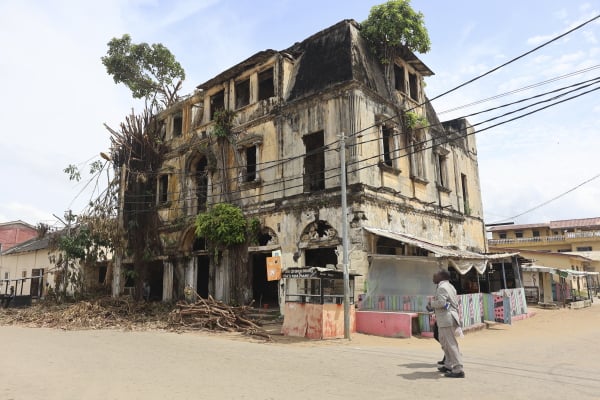
The architecture of Grand-Bassam enjoys protection as a Unesco World Heritage Site.
Grand-Bassam is situated on the coast, about one hour’s drive southeast of Abidjan. The concentration of period architecture that has survived, led it to be classified a Unesco World Heritage Site in 2012. It is one of these buildings that houses the clothing museum. The double-storey was erected in 1893 to serve as the official governor’s residence. Each floor comprises an outer corridor with shuttered, but glassless, openings that allow for a breeze to cool the inner rooms and shelter occupants from the unrelenting tropical heat.
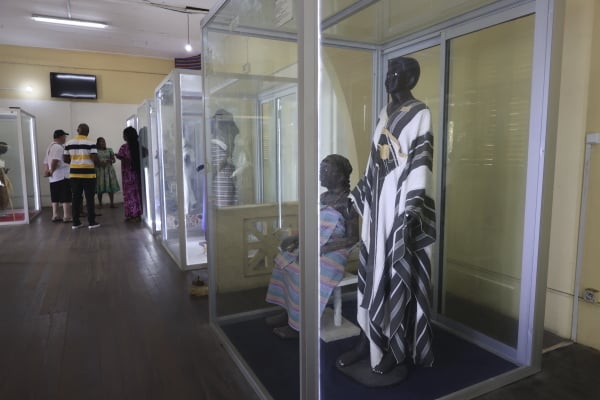
Displays of traditional attire have been used as a way of cementing national identity.
In addition to displaying the old photographs mentioned earlier, the museum’s various spaces house glass display cases with attire worn by some of the region’s many diverse communities, including chiefs and members of royalty. There are also dioramas of the different types of traditional villages across the region.
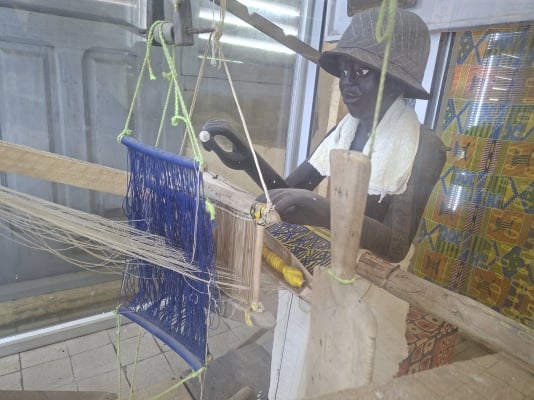
The museum includes a scale model of a traditional loom.
In one corner stands a scale model of a loom, the foundation of the country’s modern textile industry. It was the Dioula weavers who introduced the loom to many regions of Ivory Coast, particularly among the Senufo, Gouro and Baoulé peoples.
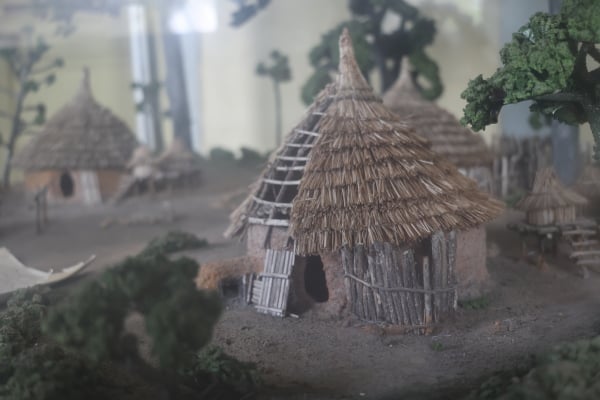
Traditional construction, such as this village representing the work of communities in the country’s northwest, forms part of the displays.
Another mention of the Baoulé relates to their welcome ceremony, which underscores, perhaps more than most, the themes behind the intention of the exhibition. A panel in the entrance lists them: The museum is a call for forgiveness, an encouragement to know the past, an acknowledgement of great Ivorians who helped build society, a tribute to the contributions of women, an encouragement to innovation, and an inspiration towards unity for the future.
The “akwaba”, or welcome display case, contains two traditional chairs – an ingenious construction resembling two interlaced triangles of rough-hewn planks and wooden poles. Stuck on the glass is an explanation:
The welcoming ceremony is held around palm wine or mezan. This sweet but sufficiently alcoholic beverage is a symbol of hospitality, conviviality and living together among the Akan. But when the host serves a lot of wine cups to the stranger, the latter becomes talkative and begins to reveal himself.
For now, there’s little chance of a break for museologist Ghislain Teya. He has a few hours to go on this shift. Furthermore, there’s no sign of slow-down in these parts any time soon, and that goes for his whole country, too.
- Photographs: Clifford Roberts/Canon R6
See also:
Die spesiespeurverhaal wat ’n Kaapse taalkundige help ontrafel
