


At just 22, François Cloete has already made his mark on British church music. Currently the senior organ scholar at Merton College, Oxford, Cloete has recently graduated with first-class honours in music and is about to take up a prestigious organ scholarship at Westminster Abbey. Alongside this, he will begin a master’s degree in musicology at King’s College London. Though he was born in the UK and raised on the island of Guernsey, Cloete proudly traces his roots back to South Africa – and his connection to Afrikaans culture remains a quiet but persistent undercurrent in his artistic identity. I spoke with him while visiting the Netherlands.
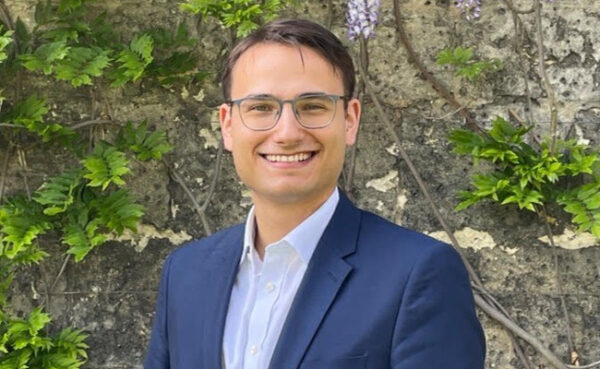
François Cloete
From piano to pipes
Cloete’s musical journey began with a childhood fascination for the piano. “I was drawn to the piano from an early age,” he recalls, “and then was encouraged to join my secondary school’s chapel choir. It was there that I came across the organ and was fortunate to take lessons from a former Westminster Abbey organist.” That early connection would prove prophetic.
Awarded a bursary to attend Wells Cathedral School, he immersed himself in the discipline of church music and discovered a lasting love for the organ’s “majestic sound”. “I enjoy the variety of roles organists perform,” he says, “as accompanists, recitalists, educators and conductors.”
At Wells, he studied with Andrew John-Smith – a student of the late Jacques van Oortmerssen at the Amsterdam Conservatorium – and later with Jeremy Cole, the cathedral organist. These formative years also introduced him to the harpsichord, conducting and musicology. “Wells shaped me deeply,” Cloete says. “I met like-minded students, performed at high-profile events and even appeared on national television as accompanist on BBC Young Musician.”
RCO fellow at age 19
By the age of 19, Cloete had already become a fellow of the Royal College of Organists – one of the youngest ever to do so – winning three prizes for the highest marks in every section. “As I hadn’t studied music at university yet, I worked very hard on the written papers,” he says, “but I really enjoyed the process.” The fellowship exam includes performance, improvisation, keyboard tests and rigorous musicological components.
Part of his prize was a recital at the Three Choirs Festival in Gloucester – a proud milestone not only for its prestige, but as professional recognition among Britain’s tight-knit community of church musicians.
Between rock and Evensong
Though he is steeped in the English choral tradition, Cloete’s South African background subtly informs his musical perspective. “Afrikaans reminds me of home, family and my childhood years,” he reflects. While not fluent, he understands the language and regularly hears it when visiting relatives. “At Christmas, I play carol tunes to Afrikaans lyrics while friends and family gather around singing.”
His wider family is not especially musical – many are dentists – but creativity crops up in different forms. “My brother plays saxophone and is studying robotics at Oxford. My dad’s a big rock fan and plays electric guitar in a band on Guernsey. I sometimes join them on stage and play keys.”
While church music may seem worlds away from rock gigs, Cloete sees connection rather than contrast. “Music helps people reflect and find peace. At Evensong, there’s something really special about the atmosphere. I’m proud to be part of that tradition.”
A change of keys
Although the organ is his primary instrument, Cloete also performs on piano and harpsichord. “They’re all keyboards,” he says, “but each requires a different technique.” The organ’s dynamic range isn’t controlled by touch, but by registration and articulation. “You have to think like a speaker – shaping phrases with clear articulation so they ‘speak’ in the acoustics of a church.”
The harpsichord, meanwhile, demands a lighter, more intimate approach. “Its sound fades quickly, so clarity and precision are essential.”
This nuanced sensitivity has become central to his style. He credits his early teachers and later mentors like Christian Wilson (Oxford) and Daniel Moult with shaping his expressive technique and deepening his interpretive insight.
Romantic drama, French mysticism – and Dutch rhetoric
Cloete’s repertoire preferences reflect his breadth of interests. “I’m particularly drawn to the Romantic organ music of Max Reger,” he says. “His chorale fantasias have intense emotional arcs that test the limits of both instrument and performer.” He performed Reger’s Straf mich nicht for his final recital at Oxford.
He also returns each year to Messiaen’s La Nativité du Seigneur – a mystical, harmonically rich cycle of meditations on the Christmas story.
Beyond composers, Cloete has been shaped by the Dutch school of organ playing – a tradition that prioritises historical fidelity and rhetorical expression. “My first teacher studied in Amsterdam,” he says, “and I followed that path during my gap year with Daniel Moult, another student of Van Oortmerssen.” The Dutch approach treats each instrument as a personality – to be understood, not overpowered.
Dutch organs, South African echoes
Cloete’s visit to the Netherlands brought him face to face with two historic instruments: the German Romantic Sauer organ in Amsterdam’s St Nicholas Basilica and the intrinsically Dutch Van Hagerbeer organ in the Hooglandse Kerk in Leiden.
“The Sauer is incredibly rich in 8’ and 16’ tone, like a Romantic orchestra,” he says. He performed Reger’s Introduktion und fuge on it – with two assistants helping him change stops by hand. “British organs usually have electric aids for that!”
Surprisingly, he ended the concert with Herbert Howells’s Te Deum, a staple of Anglican music. “It actually sounded amazing on the Sauer,” he says. “And I found out that the local organist had played it recently, too. There’s more overlap between these traditions than people realise.”
In Leiden, the Van Hagerbeer organ offered an entirely different experience. “Its mechanical action is so responsive – perfect for Sweelinck.” The tuning (Werkmeister temperament) gives Baroque chords a unique glow. “Each note has its own flavour,” he says, describing the simple joy of playing just two stops – the 8’ flute and principal – for 10 minutes straight.
That same church also houses a Father Willis organ from Liverpool, creating a rare convergence of Dutch and British organ-building traditions in one place. “I loved playing both,” Cloete says. “They tell different stories, but together they enrich your sense of possibility.”
Performer, scholar, bridge builder
Looking ahead, Cloete will begin a new chapter at Westminster Abbey – playing for national occasions, improvising, and deepening his skills as an accompanist. But he’s equally excited about his academic work.
“I’ll be studying musicology at King’s College London, focusing on twentieth-century migrant composers,” he says. “People like Egon Wellesz, who fled Austria during the Nazi regime. His music blends Austrian and British idioms, showing how sound can reflect identity.”
Ultimately, Cloete hopes to combine scholarship and performance – perhaps as a university choir director who also writes and teaches. “My dream job brings together all my interests,” he says. “Research, music-making and engaging with ideas around migration, culture and belonging.”
He’s already begun mapping out possible collaborations across the UK, the Netherlands and South Africa. “I want to explore British organs imported to South Africa and learn more about South African composers. There’s huge potential for connection.”
Notes across borders
For Cloete, music is both a tool and a metaphor – a way to explore who we are and where we belong. “Much of what ‘home’ means to me comes from different places, people and traditions,” he says. “I think this is an important idea for everyone in 2025, as the challenges we face can only be solved by bringing people together across borders. I don’t wish to suggest that music can solve these challenges, but it offers a good step forward to common respect and understanding.”
He believes that music may spring from cultural or historical origins, but can also express diverse senses of belonging across borders. Cloete cites moments of unexpected cultural resonance, such as a Dutch church holding Evensong every month as a sign that bridge-building is already happening. “For me, music is just as much about language as it is about listening to others, learning from each other.”
As he looks to the future, Cloete is clear-eyed but hopeful. “I would like to engage people with these ideas as a performer and academic. Next year, I will perform and research music by Egon Wellesz, an Austrian-British composer, but I think there are so many other musical voices who sit across national boundaries and have been sidelined for too long.” Cloete says he hopes that all this hard work will also result in more travelling and exploring, and hopefully see him returning to the Netherlands for organ recitals next summer.
