


Naar aanleiding van de tweede herdenking van de sterfdag van Breyten Breytenbach (1939-2024) verschijnt een gelegenheidsbundel met getuigenissen van dichters, vertalers en vorsers. Het huldigingsboek wordt gepresenteerd op het symposium “Inter-Breyten. Breytenbach in context” (Universiteit Gent, 26-27 november 2026).
Postumiteiten voor Breyten. Door het oog van dichters en vorsers presenteert reacties van Zuid-Afrikaanse en enkele Nederlandstalige dichters op een reeks met vragen die de voorbije maanden is voorgelegd.

Daarnaast komen vorsers aan het woord in een tweede deel. Zij spreken over hun specifieke framing van Breytenbachs werk, de accenten die ze leggen in het wetenschappelijk onderzoek. Niet alleen schrijvers en vertalers construeren hùn beelden van Breytenbachs oeuvre, ook onderzoekers dragen bij aan de (academische) beeldvorming. Zij belichten hun persoonlijke leeservaringen en geven te kennen hoe zij een aandeel hebben in de beeldvorming van Breytenbach of dus de literaire postuur, met name de “heterorepresentatie”.
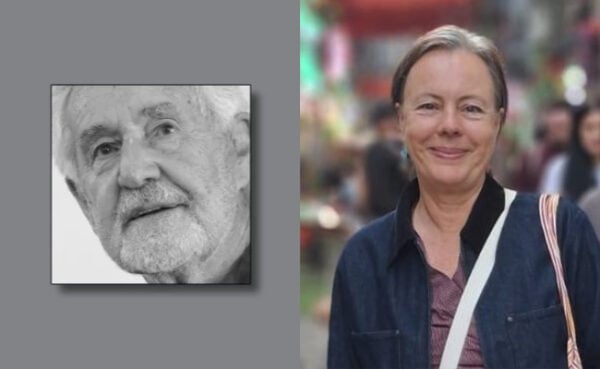
Met het oog op het herinneringsboek reageren Zuid-Afrikaanse Breytenbach-experten op een vragenlijst. De tweede gespreksgenoot is Sandra Saayman, die een van de sprekers is op het congres in Gent. Het gesprek wordt gevoerd in Engels.
...
In spite of the years in prison and exile, he was still the kind man that had given me the ‘veldskoene’ as a child.
...
YT: Can you briefly provide an overview of the scholarly work you yourself have undertaken on aspects of Breytenbach’s oeuvre? Which framing—literary studies, translation studies, art studies, cultural-historical, political-ideological, or biographical—was given priority?
SS: I was fortunate to do my PhD entitled Texte et image: la littérature de prison de Breyten Breytenbach (Texte and Image: the Prison Writing of Breyten Breytenbach) at the University of Poitiers in France, under the supervision of Professor Liliane Louvel in 2003.
The opening statement of my thesis first quoted Jorge Luis Borges, “[Q]uand on a souffert, cela demande une forme […] chaque sujet a son esthétique” (CNRS audiovisuel 1983). These words can be translated simply as: “When you have suffered, that requires a form. Each subject has its own aesthetic” (my translation). Borges pronounced these words at the Collège de France in 1983. I then went on to explain that, between 1975 and 1982, when he was incarcerated in Pretoria Maximum Security and later in Pollsmoor prison in South Africa, Breytenbach was denied the right to draw or paint. The aim of my thesis was to discover the forms inscribed in the text or adopted by the form of the written work, thanks to which the painter, deprived of his paint brush and palette, gives witness to the experience of incarceration. And in doing so, sublimates it.
Right from the start I saw Breytenbach’s painting and writing as being inseparable. He describes himself as a “footloose painter of metaphors and scribbler of colours” (The Memory of Birds in Times of a Revolution, Faber and Faber, 1996, 86). A sentence from Mouroir. Mirrornotes of a novel (Faber and Faber, 1984) also shows how intertwined word and image are in Breytenbach’s imaginary world: “It looks like a poem. He can make out the first line: ‘No, Baba – don’t trust the chains around your ankles…’. The rest is illegibly entwined in flowery letters and letter-like flowers. All of a dark blue colour” (99). The description “flowery letters and letter-like flowers” is both strange and at the same time highly visual. Words and images flow into and from one another in Breytenbach’s work. My research approach to Breytenbach’s oeuvre has always been that his writing should not be studied without also studying his painting – and the other way round.
At the time I was working under her supervision, Liliane Louvel was already at the forefront of text and image studies in France and remains so to this day. She is the author of L’Oeil du texte. Texte et image dans la littérature de langue anglaise published by the Presses Universitaires du Mirail in 1998. Her other works are Texte Image. Images à lire, textes à voir and Le tiers pictural. Pour une critique intermédiale, both published by the Presses Universitaires de Rennes, in 2002 and 2010 respectively. Her work was translated into English by Laurence Petit: Poetics of the Iconotext was published by Ashgate in 2011. Not only is Louvel’s research on the interplay between text and image in literary works very thorough, but she also gives the researcher tools for the analysis of iconotexts. In L’Oeil du texte and Poetics of the Iconotext she sets out the different types of “pictorial” texts one can encounter and proposes a hierarchy of “saturation”; the literary form that has the highest degree of visual saturation being the ekphrasis. These works provided me with a solid methodology.
The central question my thesis addressed was straightforward: I wanted to show that because Breytenbach was not allowed to paint in prison, this would have an effect on the writing he produced in prison. I set out to look for descriptions of the visual arts, but also for the transformation of everyday things into art (a tattoo of the praying hands of Dürer on the body of a fellow prisoner, for example) in his prison writing. And I made use of the labyrinth, an architectural and visual device, to try to make sense of the collection Mouroir which is a difficult work, both in terms of content and form. Those texts were written under very strange circumstances: Breytenbach could write on condition that he would hand in the pages he had written at the end of every day and he could not refer back to them. So understandably, they are labyrinth-like.
YT: Are there research findings that, in retrospect, you would like to highlight? Or, put differently: on what grounds can Breytenbach be considered a writer and visual artist of international stature?
SS: After my PhD, I decided to allow myself the freedom to do some work on Breytenbach’s paintings. Because in a PhD in literature, at the time in any case, one couldn’t give too much space to the paintings and they were relegated to the status of annexes. The main focus had to be the discipline at hand, which was literature. But I was working on texts saturated with the visual and it seemed to me that Breytenbach’s paintings and writing were two mediums that give expression to the same extraordinary imaginary world and, had he expressed himself through music or dance, for example, we would have to give all these forms of expression equal attention. And not see one as superior to another. The aim of my book, Breyten Breytenbach. A Monologue in Two Voices (Fourthwall Books, 2013), which is an essay really, was to show the relevance of placing Breytenbach’s drawings, paintings, poems, essays and works of fiction on the same table and looking at them together.
YT: Within the broad field of study, are there aspects that have so far received relatively little attention? Do you discern trends in the approaches of South African and international scholars, to some extent shaped by research paradigms that have shifted over time? In the period following Breytenbach’s passing, what areas should research focus on more strongly?
In the coming years, many scholarly and essayistic publications—perhaps also doctoral research—will be added to an already impressive corpus of critical texts (see the bibliographies in the Festschrift Woordenaar woordnar, Protea Boekhuis, 2019). Are there directions that research should preferably take, whether building on or engaging critically with existing studies?
SS: I have partly answered this question above. As many researchers have pointed out, hybridity is very important in Breytenbach’s oeuvre. There are so many examples: he paints hybrid creatures, the minotaur is central to his prison work, texts harbour descriptions of works of art and his paintings contain words and sentences. His “Lappesait” paintings look like flags hanging from a ceiling or like the pages of a book that one can walk through. The interplay between text and image in Breytenbach’s oeuvre really should receive more attention. It would be good to have a library of images to work with (I write about this in question 6). Researchers need to have access to good reproductions of the painterly oeuvre Breytenbach produced over the years. His paintings, drawings and collages are at his studio in Spain, in Paris, and in Wellington, South Africa at the Breytenbach centre and there are collectors of his work in many parts of the world. For a researcher who wants to work on his paintings (or take them into account in the analysis of his literary oeuvre) there are too few catalogues available and the reproductions are too small. Perhaps a group of scholars could put together a website with reproductions of his painterly oeuvre. One needs to be able to see the detail in the work (in a corner of a painting there will be a bit of string pasted onto the canvass and that bit of string might spell out the beginning of a word… that kind of detail is significant). I believe that this would be of great help to Breytenbach scholars in both the field of the visual arts and in literature and poetry.
YT: When surveying the research domain surrounding the literary and artistic work, which insights have been particularly formative for you as a researcher and/or have steered your work in a specific direction?
SS: I have already partly answered this in my first answer where I write about the importance of Liliane Louvel’s work to me. As far as critical analyses of Breytenbach’s work is concerned, the work of the South African scholar, Louise Viljoen, is invaluable. Die mond vol vuur: beskouings oor die werk van Breyten Breytenbach (Sun Press, 2014), for example. I even read Viljoen’s PhD (of which the viva was in 1988 and I don’t think has been published). I am also fortunate to have Louise Viljoen as a mentor. She did me the honour of being the peer reader of my manuscript A Monologue in Two Voices. I recently took the whole file of letters (written between 1969 and 1974 between Breytenbach and his publisher) I am currently working on to her in Stellenbosch. I went for a walk and left her to read the letters. I needed to have her opinion on the interest of the project before committing to it.
Marilet Sienaert’s book The I of the Beholder, published by Kwela in 2001, is an important work. As are Francis Galloway’s Breyten Breytenbach as openbare figuur, published by HAUM Literêr in 1990 and her ‘n Huldiging Breyten Breytenbach: woordenar woordnar, published by Protea in 2019.
When working on word and image studies, it is good to go back to the early academic works like Wendy Steiner’s The Colours of Rhetoric. Problems in the Relation between Modern Literature and Painting (The University of Chicago Press, 1982). Other works that were important to me were Jean H. Hagstrum’s The Sister Arts: The Tradition of Literary Pictorialism and English Poetry from Dryden to Gray, also by University of Chicago Press, first published in 1958. And Murray Krieger’s Ekphrasis. The Illusion of the Natural Sign, Baltimore and London: The John Hopkins University Press, 1992. And of course, What do Pictures Want? The Lives and Loves of Images, by W.J.T. Mitchell (University of Chicago Press, 2005), to name a few.
Following the Inter-Breyten symposium it is going to be interesting to see how research by South African scholars will interact with research by scholars in Belgium and elsewhere. I hope that co-directed PhDs, with supervisors from different countries, might also flow from this encounter.
YT: Breytenbach’s work is extensive and highly layered. It is impossible to fully approach its (inter- and intratextual or intermedial) complexity from a single literary or art-historical perspective. Are there particular angles—problem statements or research questions—that you are considering for your own (continued) study?
SS: I think I have partly answered this question higher up. I also feel that it is important that the Breytenbach archives be preserved. They too are layered. A letter by Breytenbach is never simply a letter. It always contains a literary jewel, whether in the form of a brief description of the poetry of everyday life, a funny and critical caricature of someone he dislikes, a powerful metaphor, a very eloquent joke… A letter might contain a small drawing. Just like in his literary oeuvre, Breytenbach’s letter writing stops at nothing. I am currently working on the letters written between Breytenbach and his Cape Town publisher, Daantjie Saayman, from 1969 to 1974. It is a new field and I have everything to learn. I need to read more about censorship. I need to decide whether the letters should be published as they are or whether one should write a book and quote selectively. Or do both.
YT: Finally, Breytenbach’s literary work has been translated into multiple languages and, thanks in part to translation, is read and studied internationally. How did you yourself, as an individual reader or viewer, first encounter Breytenbach’s work? How did this initial encounter unfold, and who played a decisive role in shaping your perspective? Which of Breytenbach’s texts were assigned at school or university? Which texts have you yourself included on reading lists for students—works they should definitely be familiar with? And finally, in terms of reception: which titles or artworks by Breytenbach do you consider highlights of his career as a writer and artist?
SS: My father – Daantjie Saayman of the independent Cape Town-based publishing house, Buren – published Breytenbach’s work in the late 1960s and early 1970s. I have a clear memory of Breyten, and two friends with long hair, demin jackets, earrings and leather sandals (most probably Ampie Coetzee and John Miles or perhaps James Polley), visiting us at our home in Somerset West in the early 1970s when I was around four years old. It must have been after the hike in the Cedarberg described in ‘n Seisoen in die Paradys (Perskor 1976) and I clearly remember Breyten giving me a pair of handmade leather shoes (‘veldskoene’ in Afrikaans) made in the village Wuppertal in the Cedarberg. The men smoked their leisurely pipes in the back garden and were kind to me. My first contact with Breytenbach’s poetry was when I was around six or seven years old: Breyten was in prison and my father regularly listened to a tape recording of Breyten reading his own poetry. This would be late at night and accompanied by a bottle of red wine. So, I knew the deep red wine sound and rhythm of Breytenbach’s poems years before I was able read them.
In the late 1970’s I encountered Breytenbach’s poems on the printed page when we studied them at school. They were in Die Groot Verseboek in spite of the fact that he was in prison for Terrorism. In 1986, I read and re-read Om te vlieg that Buren had published in 1971. I would read it as antidote to the stuffy ‘plaasroman’ we were made to study for matric (A-levels). I recently watched the wonderful documentaries made by Danie Marais for kykNET in South Africa, called Die Stories van Afrikaans. At one point the writer and singer, Koos Kombuis, speaks about how utterly bored he was at school with the Afrikaans farm novel they studied in Afrikaans literature classes. They nicknamed their teacher Klaas Vakie because he would put them to sleep with boredom (‘vaak’ means sleepy in Afrikaans). And he says that he and his friend used to read Breytenbach’s Die ysterkoei moet sweet under the table, as if it were pornography. He said Breytenbach’s work blew him away. I understand exactly what he means. I think that for many Afrikaans teenagers in the 1970s and 80s in South Africa Breytenbach’s work was a godsend. And a liberation. It might be difficult for people who did not grow up in South Africa to imagine how small-minded white South Africa was in the 1960s, 70s and 80s – and to imagine how much nonsense we were taught at school. Breytenbach’s poems threw windows in our minds wide open and expanded our horizons: they took us not only Paris and Rome, but also Vietnam and later Senegal and New York. And the rhythms, textures and colours of his lines introduced us to Zen Buddhist mantras and to places we couldn’t even name, but they felt wonderfully different from the stifling mind spaces our school education tried to enclose us in. Albie Sachs calls this “the multiple ghettos of the apartheid imagination” in his essay ‘Preparing Ourselves for Freedom’, published in Spring is Rebellious: Arguments about Cultural Freedom, published by Buchu Books in 1990. But of course, as I argued in my article, ‘Breyten Breytenbach’s Revolutionary Aesthetics’ (Commonwealth. Essays and Studies, 2019) and as others have argued, it is not what Breytenbach said but how he said it that was truly revolutionary.
My next strong encounter with Breytenbach’s work was with his autobiographical prison novel, The True Confessions of an Albino Terrorist. It is a work that made me sit up and remain focused well into the night. I read it in 1990 when Breyten returned to South Africa after F.W. de Klerk’s speech announcing the end of apartheid and Nelson Mandela’s liberation from prison. Breytenbach was one of the political exiles who returned and was in the country on a brief tour accompanied by the BBC. They interviewed the students on the campus of the University of Stellenbosch where I was a student and I managed to have a brief chat with him. In spite of the years in prison and exile, he was still the kind man that had given me the ‘veldskoene’ as a child. I was studying literature and started taking an academic interest in his work.
In my final year of my Bachelor of Arts at Stellenbosch Breytenbach entrusted me with the manuscript of Nege landskappe van ons tye bemaak aan ’n beminde. My father and I created Intaka (‘bird’ in isiXhosa) and Nege landskappe was published in 1993 in collaboration with the small Johannesburg-based publishing house named Hond. The collection was awarded the Alan Paton Prize.
After that I returned to Breytenbach’s oeuvre as a PhD student at the French University of Poitiers. I worked under the supervision of Liliane Louvel (who had done her own PhD years earlier on André Brink’s work). I found her approach to the hybrid text, the ekphrasis, very exciting. And in her book L’Oeil du texte she gives the scholar tools for the analysis of the “pictorial” text. This I dealt with in the first question.
I am fortunate to be fluent in Afrikaans, French and English. This helped a great deal in the analysis of Breytenbach’s prison texts and drawings, where French would sometimes be used as a secret language. The most of the prison drawings that were smuggled out of the prison have French titles, for example. Breytenbach knew that the drawings would be studied and possibly photocopied by the secret police before they were delivered, so he was probably playing with them or challenging them with these titles. I discussed the smuggling of drawings with him. He said that the drawings were being delivered in spite of the fact that it was officially forbidden to draw in prison and that his request to do so had been turned down, because the secret police wanted to keep that channel open with the hope that he would smuggle out compromising material (and reveal his political network in a letter, for example).
Another interesting facet of Breytenbach’s multilingualism is that in Paris, Afrikaans became his secret language. When he returned to South Africa from exile, at a talk at the University of Stellenbosch that I attended, a smartly dressed professor in Afrikaans literature commented on how his work was so in keeping with what was happening in literature internationally, that one didn’t have the impression that he had been cut off from literary trends, in spite of the fact that his access to reading material was so extremely limited in prison. And that his Afrikaans was so beautiful, whilst he had been living in Paris in exile since his liberation from prison. Breytenbach answered that in Paris he would hone his secret language, Afrikaans, like a diamond. That he would speak it to himself later at night. As to the other comment about his writing having kept up, he answered that one keeps up because these things are “in the air”. At another talk, at the University of the Western Cape, when someone again commented on his beautiful Afrikaans, Breytenbach answered that thankfully he had been to prison, where real down to earth Afrikaans was spoken, otherwise he would be speaking Afrikaans like a professor.
After my PhD, for what was to become the book A Monologue in Two Voices, I photographed Breytenbach’s paintings and drawings. I did so in South Africa where I photographed the Dancing the Dog exhibition in 2000, in Paris at his studio in the 13th arrondissement, in Hengelo in Holland, where I photographed the Raakruimtes exhibition in 2009 (and I bumped into Adriaan van Dis there). I was lucky because at the time a series of nine prison drawings had just been returned to Breytenbach by the wife of a prison warder who had kept them instead of delivering them to the people they were intended for. When this warder died, his wife returned the drawings. Breytenbach allowed me to photograph those drawings and they were reproduced for the first time in A Monologue in Two Voices.
I needed a library of images in order to see the patterns and the recurrence of images. A Monologue in Two Voices is a small book that required a huge amount of work. Once the manuscript was ready for publication, my publisher, Bronwyn Law-Viljoen of Fourthwall Books, told me that some of the photographs were not of good enough quality for publication. The thing with paintings is that they have their own lives. You photograph a painting at an exhibition, for example, but then it gets sold and starts another life. I had written a chapter around the ink drawing The Poet at Night, for example. We needed a better photograph of the work. Fortunately, I could remember who had bought the work at the Dancing the Dog exhibition. From La Réunion, where I live and work, I contacted the owner in South Africa and asked her whether I could send a professional photographer to her home to photograph the drawing. She also had to remove the work from its frame so that it could be photographed without the glass reflection. She kindly accepted to do this.
As far as teaching Breytenbach’s work is concerned, I teach extracts from The True Confessions of an Albino Terrorist (Faber and Faber, 1984) at second year Licence (Bachelor of Arts) level. One of the passages I teach, from the chapter ‘From Room to Room’ starts like this: “From room to room. Dying so as to be reborn. To die. To be reborn from room to room. From womb to space. From space to room. From room to coffin. From coffin to the destiny of space. From space to nothingness. From nothingness to seed. From seed to womb. From womb to pain. From pain to roomwomb. To wombroom. To another tomb. Other worms. To another room” (34).
The students initially find this passage difficult. But is a wonderful example of a finely crafted labyrinth-like text. It is also a text that, whilst allowing the reader to share the prisoner’s fear and confusion, shows the narrator’s complete control over language. The other day a third-year student came to me and told me that she has been thinking about “that text”, ‘From Room to Room’ that we had worked on a year ago when she was in her second year. Breytenbach’s texts stay with the students. And they often write very good analyses of his work, because there is nothing “comfortable” about it and they really need to think about what they are writing.
See also:
Breyten schrijven #36: Postumiteiten voor Breyten. In gesprek met Laurens Vancrevel
Breyten schrijven #35: Postumiteiten voor Breyten. In gesprek met Francis Galloway
Breyten schrijven #34: Breytenbachs lyriek door de blik van dichters, conversatie met Neil Cochrane
