



The Jordan Restaurant on the farm outside Stellenbosch
Photos: Clifford Roberts and supplied
The Jordans of Jordan Wines in Stellenbosch have always been known for their pioneering spirit and award-winning wines. Now, they have spread their wings to England and bought and rebuilt a medieval farm, where wines are made and gin and vodka distilled.
On a rare evening, a handful of guests could spend an evening with Gary Jordan, as well as his son Alex and his wife, Bianke Jordan, newly married, who now manage the Stellenbosch property with cellar master Sjaak Nelson. Guests were in for a treat: a tasting of two wines from the Jordans’ UK property, Mousehall Country Estate, under the Tidebrook Wines label, and four Jordan wines, all paired with a meal prepared by acclaimed Chef Marthinus Ferreira. The welcome drink of the evening was the Jordan Dry Rosé 2024, a light pink rosé. The winemaking team calls it their “March wine”. There is no reference to rosé on the front label, only a picture of a March lily (Amaryllis belladonna), which grows only in March.

Gary Jordan, Chef Marthinus Ferreira and winemaker Sjaak Nelson
Jacques explains: “If you drive around the farm, you'll see thousands of March lilies everywhere. They’re there for literally a couple of weeks, and they disappear. That’s the time when we know, or Gary will say, check the sugar readings on the merlot and the syrah for rosé, as I see March lilies. Then we'll pick some samples, check the sugar and start harvesting. So, that’s our reminder. When we see March lilies, it’s time to harvest the grapes.”
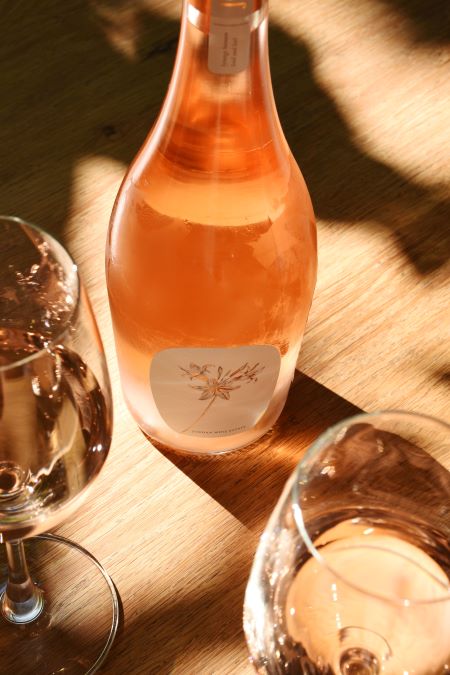
The Jordan Rosé
While sipping on the rosé and enjoying warm homebaked bread and herb butter, Gary gave some background on the Jordans’ lineage in South Africa. “My great-grandfather came out in the 1800s and started the shoe industry in South Africa in Wellington. He passed it on to my grandfather, who passed it on to my dad, and thankfully I didn't become mayor of Wellington like every other Jordan did.
“And I didn't go into the shoe business, but I really fell in love with wine and my wife to be, Kathy. We got married, and two years after our son Alex was born, we managed to acquire this property, in 1982. It was quite derelict. We uprooted old hanepoot vineyards and planted the Cobblers Hill vineyard with merlot, cabernet franc and cabernet sauvignon, and eight years later some petit verdot. It is an amazing site. The cellar was built in 1992, and the first wines were released in 1993.

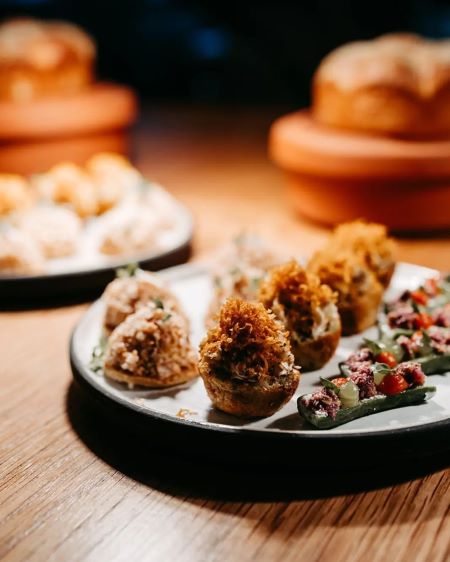
Some of the mouth-watering snacks served on the evening
“They always say, if you’re a farmer and a neighbour’s property comes up for sale, you should buy it, because it only really happens once in a lifetime. We’re lucky it happened to us five times. Jordan is now unique in that it has north-, south-, east- and west-facing slopes, and it comprises 111 hectares under vine, also with chardonnay, chenin blanc, riesling, sauvignon blanc, assyrtiko, shiraz and grenache. New plantings for 2025 include cinsult, mencia and xenomavro.”
Sjaak joined the farm in 1999. He is a director in Jordan and the current chairman of the Chardonnay Association of South Africa. His love and passion for chardonnay is evident not only at Jordan, but also at Mousehall. The farm’s Tidebrook Chardonnay recently – for the second time in a row – achieved a gold medal in England at the WineGB Awards 2024, and also received 94 points at the Decanter World Wine Awards. Gary says they are the only winery in England ever to get two golds in a row in two years. And it’s going to be an exciting wine. It’s up for the trophy and received 96 points (gold) at the 2025 Awards.
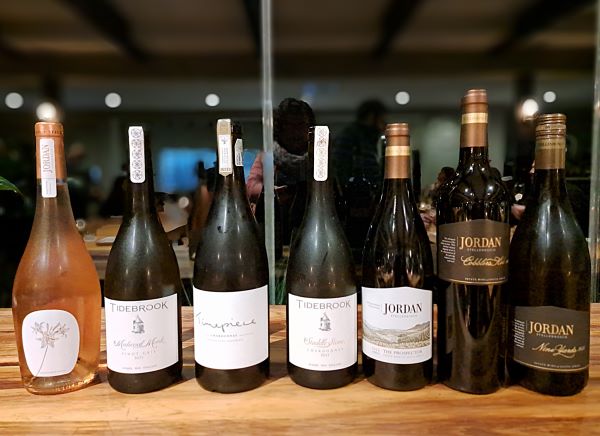
The wines of the evening were a combination of Jordan wines and Mousehall wines.
But the success of the Tidebrook wines has deeper roots: Gary selects older barrels from the Jordan cellar and ships them to England. Every barrel is unique and brings a different taste to the wines, so only the best barrels are selected. Also, the yeasts come from South Africa, as Jacques explains: “We ferment the wines with a yeast that we take from South Africa, because there is nothing available to buy. If you buy something in England for wine, you must expect to wait two weeks. You order it online, and two weeks later it’s delivered. And there is no winemaker that I know who can plan more than one day ahead,” he laughs.
......
But the success of the Tidebrook wines has deeper roots: Gary selects older barrels from the Jordan cellar and ships them to England. Every barrel is unique and brings a different taste to the wines, so only the best barrels are selected.
......
Gary relayed the story of how he and Kathy ended up at Mousehall, about 50 minutes southeast of London. “In the same year – 2009 – that we opened our restaurant at Jordan, we also opened a restaurant in London, just below Saint Paul’s, called High Timber – the only restaurant still, after so many years, with seats right on the Thames.

Kathy and Gary Jordan in the vineyards
“It’s a city restaurant, so it’s very busy Monday to Friday, lunch and dinner, and then everyone has the weekend off. And, of course, on the weekend, they will come out to the winelands. The UK wine industry has grown dramatically.
“Kathy and I thought that we were going to be real pioneers, going out there looking for property in 2017. It took six months up and down, travelling some 5 000 miles looking for property. We eventually found an abandoned old medieval farm, Mousehall Country Estate. And when I say medieval, it was already recorded in the Doomsday Books in 1086. It is all made from wood, harvested from that area. The floors are 600, 700 years old, and it’s been added onto over the centuries, but a beautiful place,” he says.
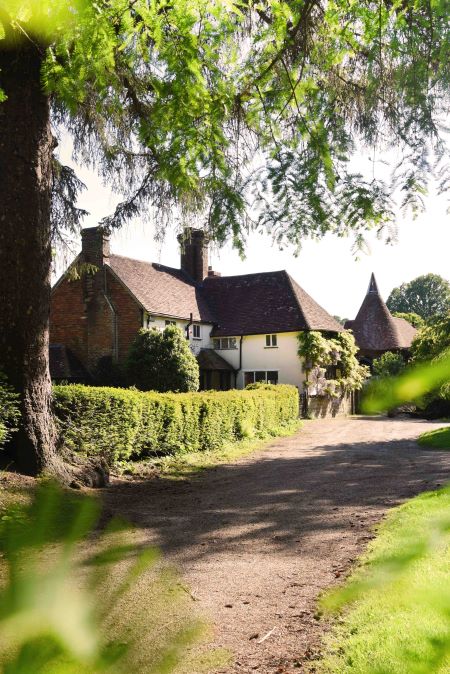
The beautifully restored homestead at Mousehall
One of the buildings was the old oast house, also known as a hop kiln, a specialised building used for drying hops, the cone-shaped flowers of the hop plant, which are essential for flavouring and preserving beer. Hops weren’t allowed by King Henry VIII.
“It was only just after he died that everybody started planting hops, because it’s pretty good in beer. And they say that where great hops and great apples grow – as they enjoy a similar climate – it is a very good place for chardonnay. We looked in that sort of part of the UK.
“Believe it or not, southeast England, where we are, receives less rain than Stellenbosch. It’s incredibly hot and dry. We have subsequently converted that old oast house to luxury accommodation for visitors. We started planting our vineyards, with Jacques’s help, in 2019. It was the same year that we planted our assyrtiko up here at Jordan. We planted chardonnay and pinot noir in Sussex, and assyrtiko here at the top of the hill.

The old barn, converted into the distillery and winery

“We started off making gin and vodka, and that was in an abandoned barn which we turned into a distillery and winery and home to a 400-litre traditional Mueller copper pot still, called Amahle, meaning ‘The Beautiful One’.”
Their daughter, Christy, is the distiller, and the three of them have been cultivating the land, planting and sourcing botanicals, and launching their first product, Mousehall Sussex Dry Gin. This classically London dry-style gin is produced from both grape and grain neutral spirit, together with 13 different botanicals, to create a perfectly balanced juniper-forward gin. Hints of fresh citrus, cardamom and a special South African ingredient, rooibos, add a floral element to this refreshing and zesty gin. The gin has won numerous accolades.

Christy Jordan checking the gin’s ABV
Gary adds: “If you come and visit us at Mousehall, you will see all those atrophic marks, all these witch’s marks or hexagons. The buildings are full of them, and this was to ward off evil spirits. Now, when you look at the seal of our rosé, called Six Petals, six petals will be quite obvious, and this was to ward off evil spirits coming down the chimney.”
Today, Mousehall is home not only to their chardonnay, pinot noir and pinot meunier vineyards and various gin botanicals, but also to Dorper sheep and 16 beehives. Gary says: “Another great South African connection between our two homes is that we farm regeneratively there as well, and we’ve got this herd of pedigree Dorpers, bred in South Africa. They’re really great meat sheep. The problem is that we had this whole herd. They then had babies. Unfortunately, because they have pedigree, they all have to have names. And so, number six is called Khaleesi. And you can't eat Khaleesi. So, Khaleesi fertilises the fields – and the ladies as well. They are all very happy sheep. But when Khaleesi dies, then they’re off,” Gary concluded.
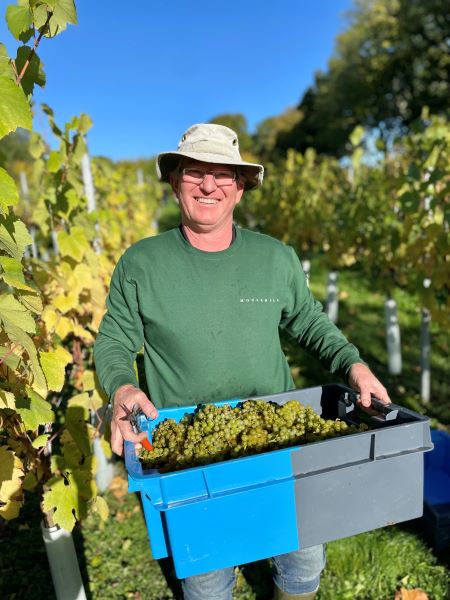
Gary with Mousehall Chardonnay
Their grapes come from three different areas, and everything in the vineyards and cellar is done by hand. Their grapes all come from the Sussex PDO (protective designation of origin), a unique edge above all other wine farms in the country. The wines are aged in various vessels and blended before bottling.
Gary says, “I was a geologist in my previous life, and I love walking around vineyards looking at the different rocks and things. We happen to have four different climates there, with completely different soil types, and that gives you building blocks to make really great wines.”
The evening’s formal tasting started with the Tidebrook Medieval Monk Pinot Gris 2023. Gary gave some background. “The most prevalent and single most planted grape variety was in Burgundy in the Middle Ages. Pinot gris and the gris didn't just come from the colour of the grapes – because it’s got like a pinkish grey colour. It was actually named after the cape of the Cistercian monks. These guys were fantastic farmers. They arranged agriculture like you can't believe, all around the world.”
And as they built new monasteries, they would take their pinot gris vines with them. So, it’s the grape variety with the greatest number of names, and each country has got a different name, like in Germany it would be ruländer or pinot grigio, and especially in Italy, malvoisie or fromenteau. In some regions, it is known as szükerbarát (which translates to "grey monk"). “It’s unpronounceable in Hungary.”
Gary added, “And pinot gris is obviously a relation of pinot noir: pinot noir, pinot blanc, pinot gris. They look different. And at Mousehall, even on one vine, you'll notice the difference, not just in leaves, but also on the bunches themselves, going from a slightly pinkish colour to a slightly greyish colour.”
Sjaak adds that they own one farm in Sussex, but rent another property close by because they don't have enough space. They harvest the grapes on this farm, Hidden Springs. “We make this wine like a sauvignon blanc, because in England, when you talk about pinot gris, they think it is like a sauvignon blanc,” he explains.
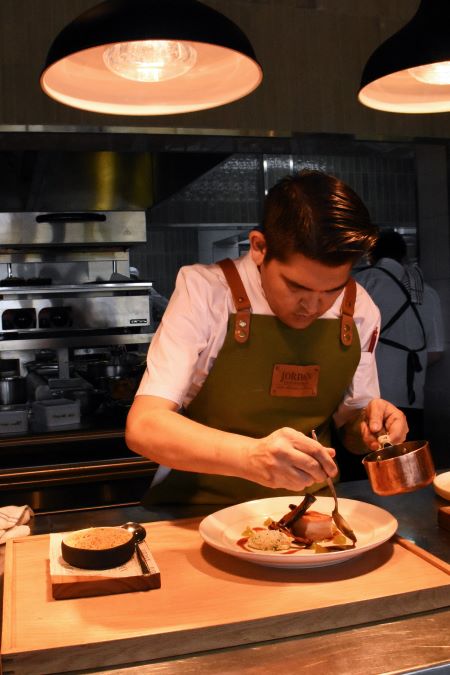
Chef Marthinus Ferreira preparing our meal
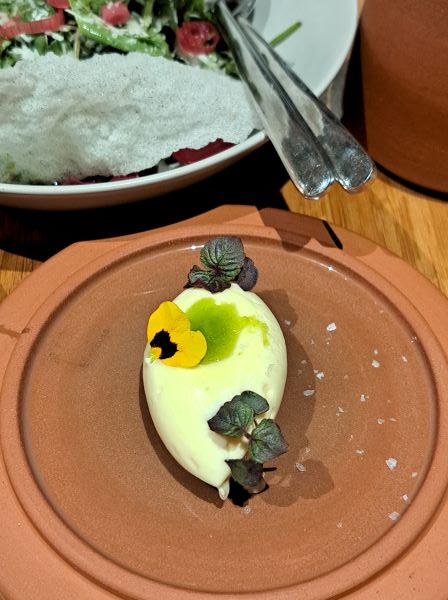
Even the butter is a small culinary artwork.
In between all the talking and banter and laughing, Chef Martinus served cheese croquette, apricot gel, pine ring parfait, pickled mushrooms with a seed cracker, confit duck, smoked duck breast, chestnut puree and pickled beetroot with the Tidebrook Pinot Gris 2023 and the Jordan Timepiece Chardonnay 2023. The mains of beef and cabbage cottage pie, pickled red cabbage, smoked fish brandade, prawn risotto, panko onion rings and rouille, gnocchi, spiced carrot puree and pickled carrot with sunflower seed brown butter, was paired with the Tidebrook Staddle Stone Chardonnay 2023, the Jordan Prospector Syrah 2022 and the Jordan Cobblers Hill 2021.
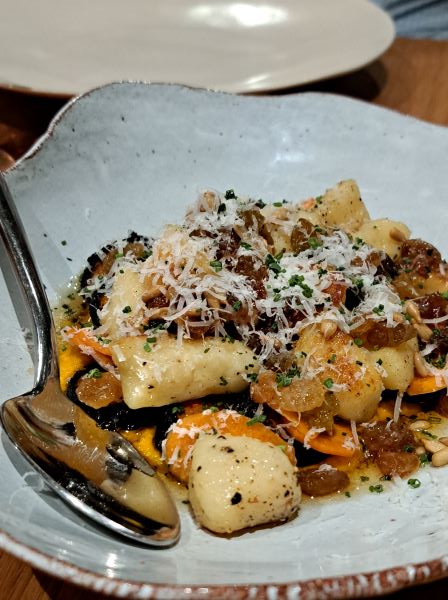
Gnocchi with spiced apricot puree, pickled carrot and sunflower seed brown butter
The Jordan Restaurant, with Marthinus Ferreira, is a firm favourite in the Cape Winelands.
Sjaak explained where the Prospector label originated: “In 2010, we got this notice on the front gate to say that they were going to mine tin on the property. And if the government wants your farm, they will take it. Gary had to go and fight the government, and he got all his neighbours involved. We saw Gary the one day, and we didn't see him again the whole of August 2010. He just disappeared. And he fought the government for our farm and other farms, and he actually defeated the government. He’s very feisty. The team decided to name the wine that comes from the vineyard where the tin mining would have happened, The Prospector.”
Sjaak says: “Jordan is also the only farm in Stellenbosch, and in the whole of South Africa, that has an old vine range, with grapes coming from the property. Everyone will buy in fruit from Citrusdal or Koekenaap or somewhere in the country, and release a wine with a funny word for a wine label as their own heritage wine. But the grapes for their ranges do not come from their farms. The heritage seal is awarded to vineyards that are older than 35 years old. This is our heritage range. We have a riesling, a chardonnay, the only cabernet sauvignon old vine in the country, a sauvignon blanc and a chenin blanc.”
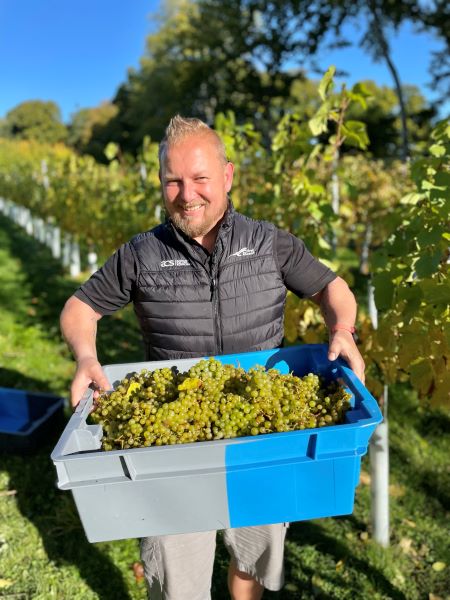
Sjaak Nelson busy with the Mousehall harvest
Gary adds that the amphora was introduced at Jordan in 2019. They were very proud that finally, after 20 years of quarantine, they had South Africa’s first mother block of this ancient Greek variety, the assyrtiko, that they had just planted. He expands: “We were discussing the wine style. We'd already done a big tasting of different wines, and we said, quite definitively, that we were not going to make assyrtiko in barrel. It really should be an amphora. And, despite cash flow being tight, we ordered amphora, as we feared messing up the assyrtiko.” Jacques adds, “Amphora can be singular or plural. The first order I bought, was four amphorae, not one. We had to hide it from Gary.”
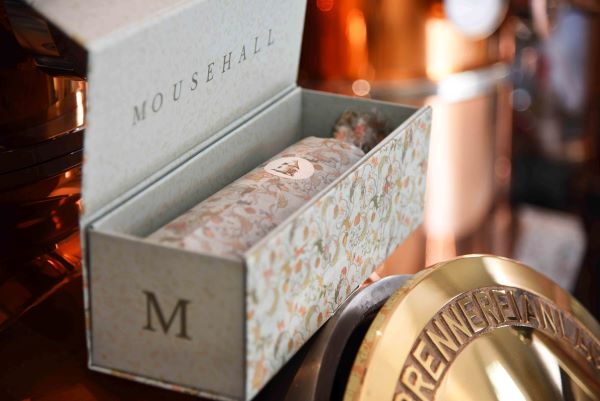
The Mousehall Gin is already a favourite.
But that is how the Timepiece range started to evolve. Only the best, oldest vineyards on the property were selected for vinification in amphora. Gary says the result was incredible. “Each year, we’re buying more amphora, because it’s such a wonderful style. What you want with these concrete eggs is not too much of an oak influence. What you taste in the assyrtiko – the third vintage is now available – is an expression of what’s coming out of the vineyard, not necessarily what the winemaker can do with oak. And that’s the secret to making these great wines.”
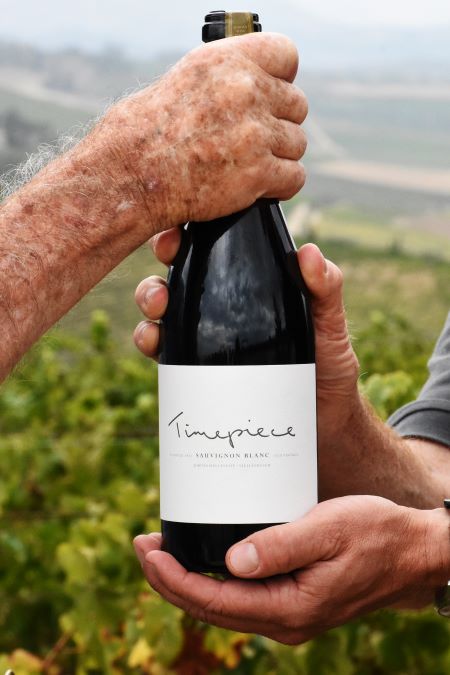
Heritage: Ted, Gary and Alex Jordan holding a bottle of the Timepiece at Jordan
Dessert of Belnori goat’s cheese snow, meringue, persimmon jam, and apple crumble and brandy crème anglaise with Chantilly cream was served with the Jordan Nine Yards Chardonnay 2023.
Mousehall released their 2022 maiden vintage Tidebrook Rosé, Chardonnay and Pinot Noir a few years ago, and now the 2023 Pinot Gris and 2023 Chardonnay are also available.
- You can now also book wine and distillery tours and tastings at Mousehall, Wadhurst, East Sussex, TN5 6PG, United Kingdom, at nick@mousehall.com or +(44) 7368400787.
Also read:
Rondom thali om die wêreld en nou by die Silo Hotel se Willaston Bar
Nuwe baadjie vir Spier Hotel, maar dieselfde goeie beginsels
