


- Photos: supplied
The conservation contributions of local wine farms towards the work done by the Cape Leopard Trust (CLT) are an important part of the overall vision to ensure a safer future for these cats.
“The Cape Leopard Trust is a registered environmental NGO and non-profit organisation based in the Western Cape, facilitating and promoting the conservation of biological diversity, with a focus on the leopard as a flagship species. Our purpose and vision are to ensure the continued survival of leopards for the benefit of nature and society,” says Jeannie Hayward, communications manager at the CLT.
“We work to support the protection of leopard habitat and prey species, promote peaceful coexistence between leopards and people, and foster community custodianship of the Cape’s unique biodiversity. To achieve this we employ a three-pillar approach of research, conservation, and education. These three pillars operate in synergy within the Cape Leopard Trust and in collaboration with communities, private landowners and partner organisations.”

The CLT is celebrating its coming of age this year. Founded in 2004 with the financial support of a few core funders (one of which was Leopard’s Leap Family Vineyards), the initial aim of the project was to research leopards in the Cederberg Wilderness. The CLT has expanded substantially over the past 21 years and has matured into an established and reputable organisation with research, conservation and education initiatives spanning the Western Cape.
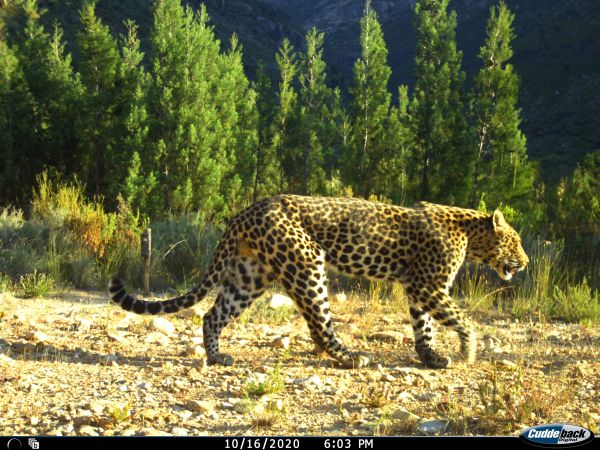
Leopards (Panthera pardus) are the most adaptable of the big cats, living in a variety of habitats ranging from rocky deserts to lush jungles to rugged mountains. They hunt a wider range of prey than any other big carnivore and can even thrive close to big cities.
........
Although leopards in the Cape mountains are geographically isolated from other populations in South Africa, and have some unique morphological, ecological and genetic characteristics, it is not enough to classify them as a subspecies.
........
Many people are unaware that leopards are still found all along the mountainous regions of the Cape Fold Belt in the Northern, Western and Eastern Cape. These leopards are the same subspecies as the ones found elsewhere in Africa – the African leopard, or Panthera pardus pardus. Although leopards in the Cape mountains are geographically isolated from other populations in South Africa, and have some unique morphological, ecological and genetic characteristics, it is not enough to classify them as a subspecies.
“We therefore do not call them ‘Cape leopards’ or ‘Cape mountain leopards’, but rather refer to this population as ‘leopards of the Cape’ or ‘leopards of the fynbos’ to avoid confusion, since ‘Cape leopard’ sounds like a different species of leopard, which it is not,” Jeannie explains.
Leopards in the Cape are generally smaller with a slighter build than those found elsewhere in Africa, being about half the mass. On average, females in the Cape mountains weigh about 20 kg and males about 35 kg.
But this elusive predator is endangered.
Jeannie says globally leopards are classified as vulnerable by the IUCN and their population is decreasing. “There is no definitive total for the number of leopards in South Africa, and current estimates vary. Leopards in the Cape region (Western, Eastern and parts of the Northern Cape) exist at much lower densities than their bushveld and savanna counterparts, and their total population is not big at all.
“Leopards in the fynbos biome also have exceptionally large home ranges, with territories being more than 10 times larger than those of leopards of the savanna. Needing such large territories and with only limited suitable habitat available, means that far fewer leopards can fit into an area, resulting in low population densities.”
.......
The leopard is the top predator in the fynbos mountains of the Cape and plays a key role in maintaining the mountain ecosystem in terms of prey numbers and the abundance, behaviour and densities of smaller predators.
........
The leopard is the top predator in the fynbos mountains of the Cape and plays a key role in maintaining the mountain ecosystem in terms of prey numbers and the abundance, behaviour and densities of smaller predators. The leopard is a so-called umbrella species – conserving the leopard is essential to conserving other local species as well as the leopards’ prey base.
The leopards’ mountain habitat also serves as a crucial water catchment area for urban and agricultural use, and conserving leopards thus leads to broader habitat conservation additional to species-only conservation.
Historically, they were classified as vermin and people were actually paid to shoot them. This continued unabated for more than 300 years, but despite this intense pressure on the population, leopards have managed to persist, finding refuge in the rugged mountain ranges of the Cape provinces.
Leopards are now protected, but they still face several serious threats – notably habitat loss and fragmentation due to urban and agricultural development; direct persecution in retaliation against livestock losses; and a reduction in their prey base due to snaring and bushmeat poaching. Other threats include too frequent large-scale veld fires, roads and traffic and rodent poisons.
However, it is not just local conservation experts and NPOs that must do their bit to protect and preserve both the natural habitats and the safety of these cats. The responsibility falls to each of us to aid wildlife conservation, create awareness around threatened or vulnerable animal species, and give back to worthy causes and conservation efforts.
The CLT shares a few pointers on how the public can help to alleviate these threats:
- While spending time in nature, be on the lookout for wire snares. Cut and disarm these snares and report them on app.capeleopard.org.za. Also report any other suspicious activity, like other types of traps and feral dogs.
- Members of conservancies, hiking clubs, MTB clubs, neighbourhood watches etc, can make concerted efforts to gather regularly for snare patrols on private properties (following due process with permission from the owner/manager), like community-driven alien clearing hacks.
- Drive slowly and carefully through mountainous areas to avoid hitting and injuring/killing wild animals, including leopards and their prey.
- Farmers can adopt holistic livestock husbandry practices to avoid conflict with leopards.
- Property owners can refrain from hunting/killing agricultural or garden “pests” like porcupine, grysbok, duiker and hyrax, as these are leopards’ main prey.
Leapord’s Leap and conservation
Leopard’s Leap is strongly committed to the conservation of these beautiful animals to protect them from extinction. Jeannie says, “Leopard’s Leap is one of our longest standing supporters and have over the years hosted several campaigns to help raise awareness of the CLT and to help fundraise for us; they have supported us with wine for countless events, and they have contributed significantly in terms of financial support. They’ve been instrumental in helping the CLT grow into the organisation we are today.”
She goes on to say that one of the greatest boons to having wine farms involved and excited about leopards and conservation is that it helps the CLT to reach a whole different audience that they would not otherwise have access to. Many wine farms have vast online and social media followings, and it is great to leverage that to help get the leopard conservation message out.

Jeannie says many wine farms are involved with the CLT in different ways and to varying degrees. “Some simply allow us access to their properties to do our research, some have their own camera traps and contribute leopard records to our database, and some support us with sponsorship in kind or financial donations. This includes many properties in the greater Boland/Winelands, Cederberg, Piketberg, Overberg and Little Karoo.
.......
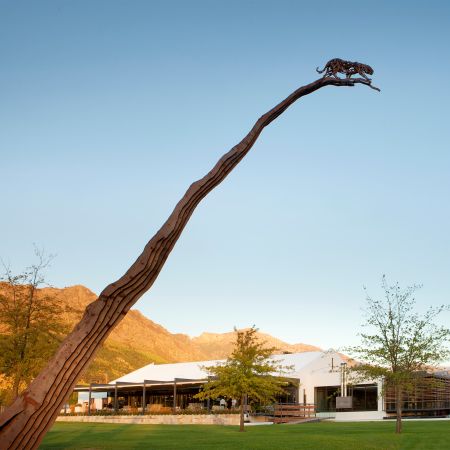
Leopard’s Leap has become a household name, famous not just for its incredible wines, great food and family-friendly atmosphere in Franschhoek, but also for its innovation, responsible farming and admiration for the local nature and landscapes that so powerfully inspire both its winemaking process and its wines.
.......
“Many wine farms have natural habitat bordering their vineyards. We urge them to obtain their own camera traps and start monitoring biodiversity on their land, not only for leopards, but also all the other wildlife that roams these edge habitats. People will not conserve what they do not know. And of course, with the CLT being a non-profit NGO, any financial support is always much needed and highly valued.”
Leopard’s Leap has become a household name, famous not just for its incredible wines, great food and family-friendly atmosphere in Franschhoek, but also for its innovation, responsible farming and admiration for the local nature and landscapes that so powerfully inspire both its winemaking process and its wines.
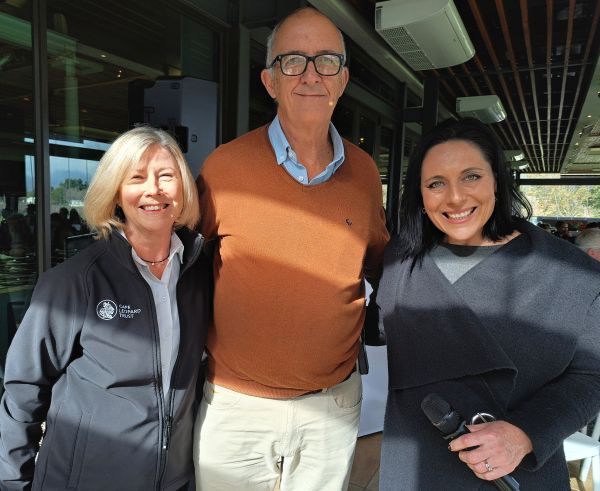
Helen Turnbull (CEO of the Cape Leopard Trust), Tony Park (author) and Mareli Roux (senior public relations officer for Leopards’ Leap and La Motte)
“The choice to actively support and fund the protection and conservation of the leopards of the Cape has always been a straightforward one. Leopard’s Leap helps to support some of the Cape Leopard Trust’s conservation initiatives and find innovative ways to focus attention on the plight of these special cats. Guests and wine lovers are invited not only to enjoy Leopard’s Leap wines, which include a very special Pardus red wine blend, but also to share in our passion for food, literature and conservation,” says Mareli Roux, senior public relations officer for Leopards’ Leap and La Motte.
Hein Koegelenberg, CEO of Leopard’s Leap, says the soaring mountains that frame their Franschhoek vineyards are home to some of nature’s territorial roamers. One of them is the shy but imposing leopard, Panthera pardus.

Helen Turnball and Hein Koegelenberg
“Our involvement in the CLT ensures that we assist in revealing the mysteries and meanders of the leopards of the Cape, one of which was named Pardus by the CLT. Just like Leopard’s Leap wine brand. At the same time, by practising ancient processes, we uncover the full dimension of our regional wine varieties. It’s all part of our contribution towards preserving the art of winemaking alongside the natural treasures of the Cape.”
Pardus, a special red blend by Hein, is inspired by the King of the Cape Mountains. This popular red wine not only recognises the intense charisma, gentle approachability and feline elegance of these wild cats, it also honours the Cape’s natural beauty and rich biodiversity.
Hein says: “Pardus is the Latin for panther or leopard, and of course a fitting name for an addition to the Leopard’s Leap collection of wines. Other than acknowledging a lifelong commitment to the protection of our natural treasures (especially through our support of the Cape Leopard Trust and the plight of the vulnerable leopards of the Cape), Pardus is an elegant red blend, celebrating my passion for wine and an everyday quality lifestyle.”

Hein Koegelenberg and Renier van Deventer
He says the 2022 Pardus – the fourth vintage of this label – is elegant, made from 42% merlot, 24% cinsault, 34% cabernet sauvignon. Grapes were handpicked and hand sorted before individual fermentation. The merlot and cabernet sauvignon were matured separately for 18 months in a combination of new and used French oak barrels and the cinsault for 12 months.
Each component was matured separately in French oak barrels. The merlot was matured for 18 months – 33% in first-fill, 33% in second-fill and 33% in third-fill barrels. The cabernet sauvignon was also matured for 18 months – 50% in second-fill and 50% in third-fill barrels. Cinsault maturation of 12 months took place in third- and fourth-fill barrels.
“The nose is layered with multiple dimensions. A lively combination of red and purple fruit aromas, with subtle spices, follow through on the palate. Pardus is a sophisticated and elegant wine with great balance between the fruitiness, oak and spices. It lingers with a finish that is long and elevated by the fine and ripe tannins, making it a well-structured and balanced wine. Elegance captured in a bottle.
“A great pairing for hearty tomato or oxtail-based stews, lamb bredie, mild and sweet spicy dishes such as Cape Malay curry or bobotie. It is also an impeccable pairing with matured hard cheese,” states the tasting notes.
- International Leopard Day is celebrated on May 3.
- Contribute to leopard research by reporting leopard signs and sightings from the Western, Eastern and Northern Cape on app.capeleopard.org.za and follow their plans for International Leopard Day at @capeleopardtrust on Facebook, Instagram, LinkedIn and X.
- Read more about the Cape Leopard Trust at https://capeleopard.org.za, Leopard’s Leap at https://www.leopardsleap.co.za, and International Leopard Day at https://www.internationalleopardday.org.
Lees ook:
Nuwe baadjie vir Spier Hotel, maar dieselfde goeie beginsels
Vier vanjaar Internasionale Chenin-dag met ’n besondere vrou in gedagte
