


The book Meerlust: Beyond the Rubicon, written by Emile Joubert with photos by Alain Proust and Richan Bakkes, published by Jonathan Ball Publishers
- Photos: Clifford Roberts and supplied
Meerlust Wine Estate – in the heart of the Stellenbosch wine district – has many reasons to celebrate in 2025: It has been producing estate wine for half a century, the Rubicon red Bordeaux blend celebrates its 45th anniversary, and a new book has just been released on the history of the farm.
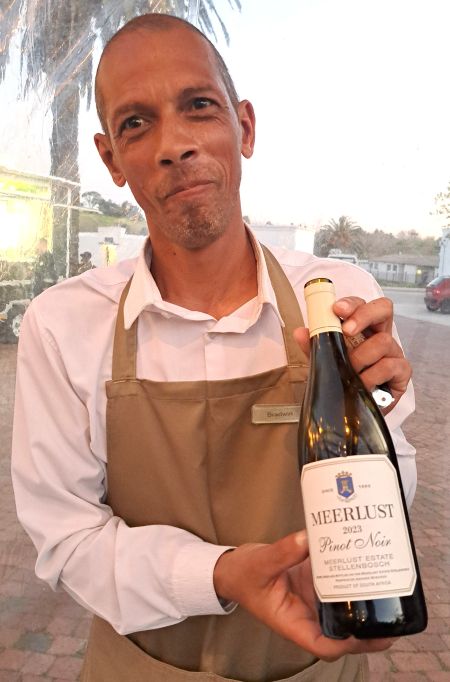
Guests were welcomed with some chilled wine on arrival.
These milestones were celebrated with a swanky function on the estate recently, coinciding with the Cape Wine 2025 show in Cape Town. Wine buyers from all over the world joined the festivities and had the opportunity to taste older vintages of the estate’s chardonnay, pinot noir, estate red, cabernet sauvignon and Rubicon. The oldest vintage of Rubicon available for tasting was the 1983, the oldest cabernet sauvignon the 1978, the oldest estate red the 2011, the oldest chardonnay the 2021, and the oldest pinot noir the 2023. Recipes from the new book, prepared by some of South Africa’s most famous chefs, were served at various food stations in the cellar and tasting room.
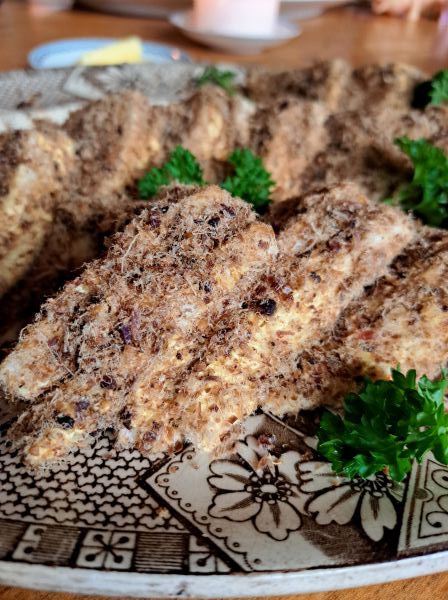
The famous Meerlust “biltong broodjie” that is loved by everybody visiting the farm, and which blew the socks off the overseas visitors. This is a recipe from Hannes’s long-time housekeeper, Tannie Bettie. Tannie Bettie always used the best butter and highest quality biltong that she could find for these sarmies.
Growing fine wines on the Meerlust Estate has been part of the Myburgh family tradition for eight generations, beginning in 1756. The estate is situated 15 kilometres south of Stellenbosch. It hosts a graceful manor house, a classical wine cellar, rose gardens, a family cemetery, a dovecote and a bird sanctuary. The estate is a national monument.
The first owner of the property, a German immigrant named Henning Huising, recognised the beauty and potential of the farm and settled here in 1693. He named his new-found home “Meerlust”, meaning “pleasure of the sea”, as the manor house sits on a granite outcrop only five kilometres from False Bay. In the warm summer months, the vineyards are refreshed by ocean breezes and evening mists which roll in from the coast.
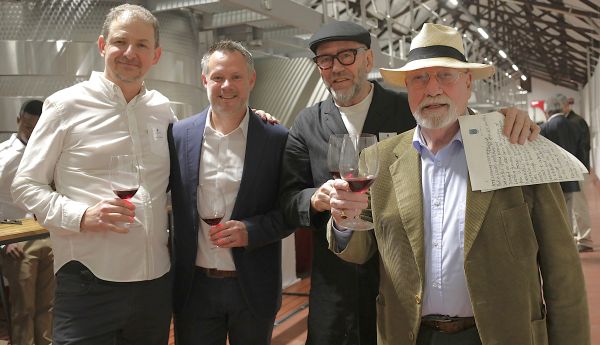
The three winemakers in the estate's history: Chris Williams (2004-2019), Wim Truter (2020-) and Giorgio Dalla Cia (1978-2004) smile with Hannes in the cellar.
For over three centuries and eight generations, the land has been cared for by the Myburgh family, who have transformed it into one of the country’s most revered wine estates. For the first six generations of Myburgh stewardship, the vineyards produced generic wines that were sold on to the major traders dealing in South African wine at the time. In 1975, the estate produced its first vintage – a cabernet sauvignon – under its own label.
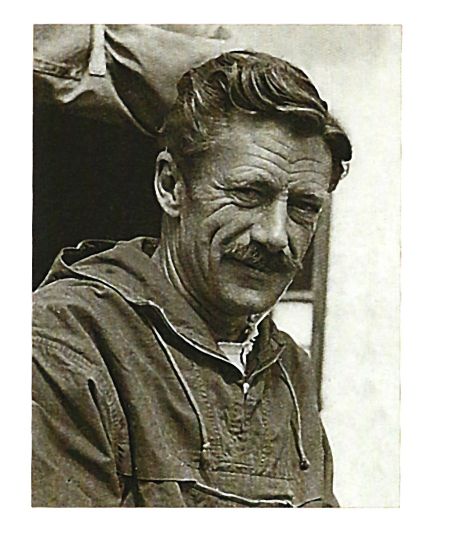
Nico Myburgh, the seventh generation Myburgh on Meerlust, made a couple of bold steps to change the course of the farm forever.
The Rubicon blend, first made in 1980 by Nico Myburgh and the Italian-born winemaker Giorgio Dalla Cia, set Meerlust on a new trajectory. It marked not only a new era for Meerlust and the Myburgh family, but also a revolution in South African wine style. Today, this legacy lives on under owner Hannes Myburgh and cellar master Wim Truter, only the third winemaker in the history of the estate, after Giorgio Dalla Cia (1978-2004) and Chris Williams (2004-2019).
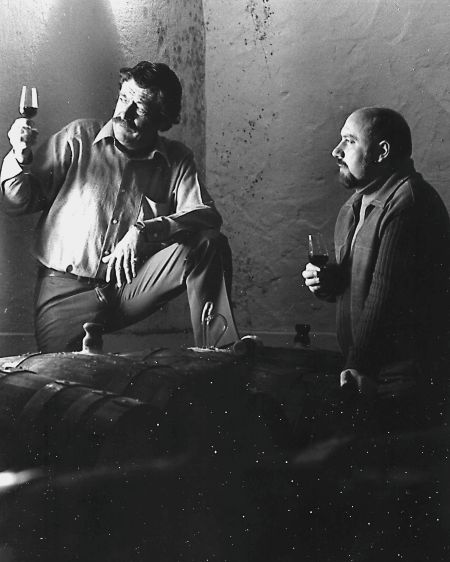
Nico Myburgh and his Italian-born winemaker, Giorgio Dalla Cia, set Meerlust on a new trajectory with the Rubicon.
Hannes told guests that the first owner died in 1713 without an heir, and the farm was then bought by the Blankenberg family, who in turn sold it to Hannes’s ancestor, Johannes Albertus Myburgh, in December 1756.
“My father, Nico, inherited it in 1959, and together with my mother, Jean, they started restoring the beautiful buildings with great love and care. My dad was a passionate and exceptional farmer and initially supplied co-ops with these well-grown grapes. But in 1975, he decided to create his own label, hence the birth of the 1975 cabernet sauvignon. Then, in 1980, two years after Giorgio joined the farm, the Rubicon was created.”
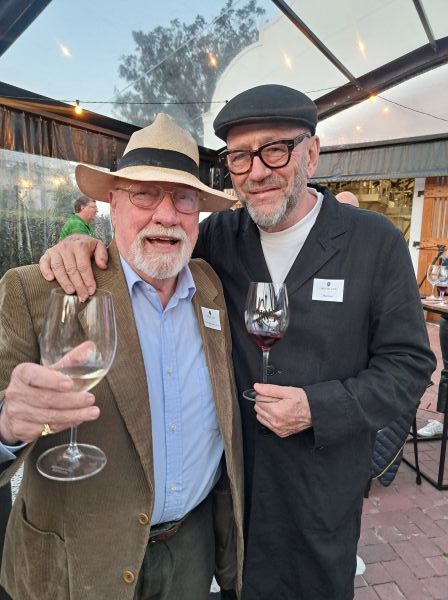
Italian-born winemaker Giorgio Dalla Cia served as winemaker at Meerlust for 25 years from 1978-2004. Here he poses with owner Hannes Myburgh.
He said the Rubicon dream started much earlier, in 1967. “When my parents went to Bordeaux, my father was absolutely enthralled by what he saw there, because it was very similar to what we have here – the proximity to the sea, the sunshine and similar soils.
“And he started this dream. When Giorgio arrived in 1978, they grew this dream together and started the alchemy of blending and wanting to get the essence of Meerlust in a glass. The first blend was 70% cabernet sauvignon, 20% merlot and 10% Pinot Noir. It has changed over the years, as every vintage is different.”
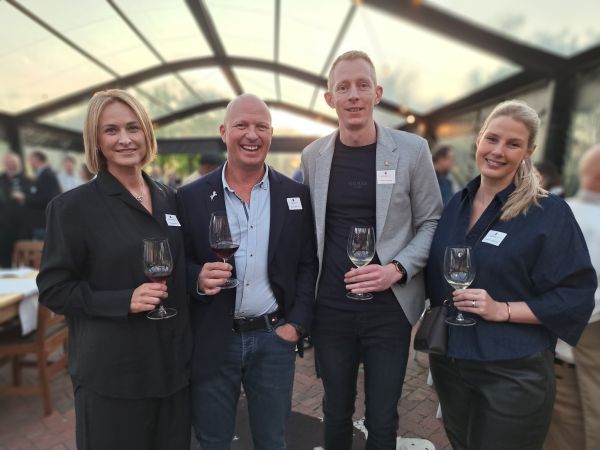
Tracy McAvoy and Jason McAvoy, CEO of Norman Goodfellows, and Wikus and Nathalie Human from Marble Restaurant
He told guests how the name came about. The wine needed a fitting name, as there was a lot of adversity against the two men, because their wine was new. “It was a change of direction in the red wine industry in the Cape, and there was a lot of resistance in the industry, and my father and Giorgio were really the target of their rudeness.
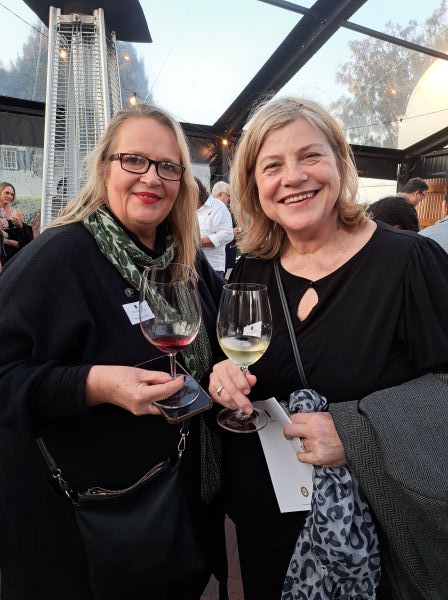
Elmarie Rabe, manager of Stellenbosch Wine Routes (SWR), and Amanda de Klerk, vice chair of SWR.
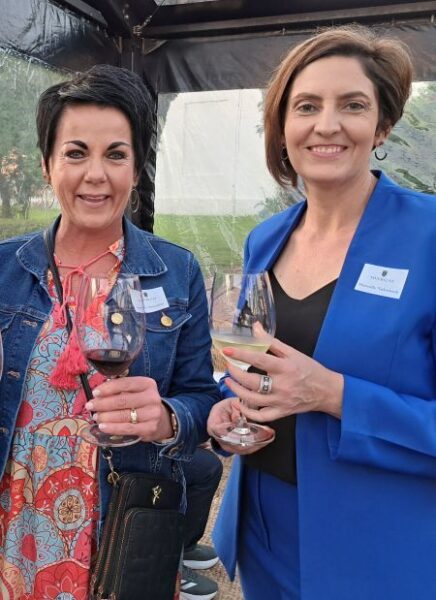
Wine club members at the celebration are Suzette Pretorius and Marcelle Volschenk.
“A change in direction is not exactly the comfort zone that people are used to,” he explained. A friend visited the farm and declared that their situation reminded him of the “predicament that Julius Caesar found himself in, in 49 BC, when he had to cross that little river in the north of Italy against enormous odds. That is how this wine got its name, because my father and Giorgio crossed the Rubicon – because once you’ve crossed the Rubicon, you can’t turn back.
.......
“That is how this wine got its name, because my father and Giorgio crossed the Rubicon – because once you’ve crossed the Rubicon, you can’t turn back.” – Hannes Myburgh
.......
“The first vintage was released in 1984, but my father sadly passed away in 1988, too early to enjoy the full success of his venture.”
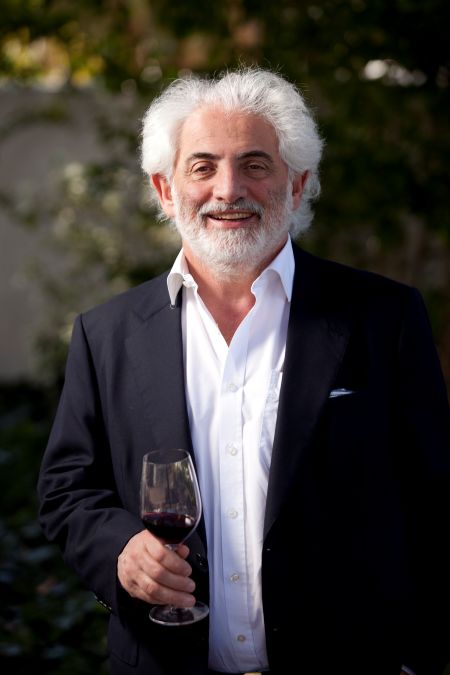
Michael Fridjhon, South Africa's leading wine writer, most widely consulted liquor industry authority and wine judge
The guest speaker of the evening was Michael Fridjhon, South Africa’s leading wine writer, a widely consulted liquor industry authority and a wine judge. Michael said: “We are celebrating the half century of modern Meerlust, something of a curious occasion: Meerlust has been producing wine for considerably longer than 50 years, and it has also belonged to the same family since 1756 – making it the wine estate with the longest history of continuous family ownership in South Africa, and surely one of very few in the world.
“Baron James de Rothschild acquired Lafite more than a century after the Myburghs had settled on Meerlust. The Leroys and De Villaines at Romanee-Conti were relative late-comers compared with the Myburghs. There are producers and vignerons whose foundation date reaches back into antiquity – but few I can think of who are as profoundly connected with the culture of wine in their country of origin.”
He continued that in this context, the past 50 years is important, for it was under Nico that Meerlust went from a splendid Stellenbosch estate with one of the country’s most important historic homes to one of very few Cape “first growths”. It holds extraordinary significance for both the estate and the Cape wine industry. The year 1975, though, marked a turning point. Globally, it saw the fall of Saigon, the sentencing of the Watergate conspirators, Margaret Thatcher’s rise to Tory leadership, and a UN resolution condemning apartheid and calling for sanctions against South Africa.
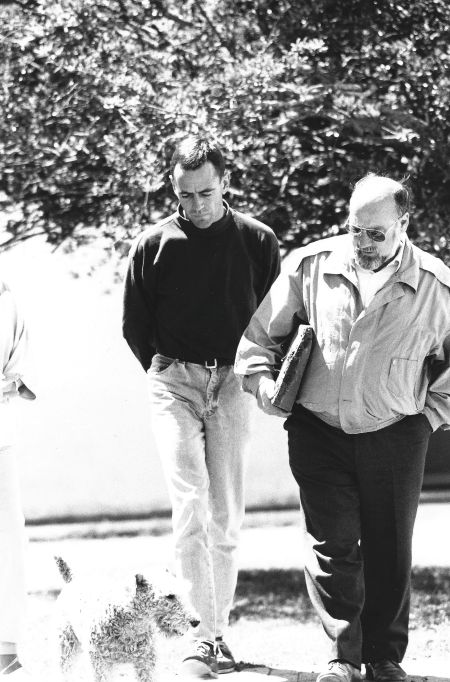
Hannes Myburgh and Italian-born winemaker Giorgio Dalla Cia
That last event is crucial, not merely for its politics, but for the perspective it offers on how much has changed since. In the mid-1970s, the Cape wine industry was tightly controlled by the KWV, which exercised near-total authority: it decided where and by whom vines could be planted, and monitored every transaction to ensure that no wine was sold below the fixed minimum price.
In 1975, South Africa produced about 700 million litres of wine, but only 140 million litres were sold locally – more was distilled than drunk. The industry looked very different then: over 7 000 grape growers, about 70 co-ops, fewer than 30 estates and only a handful of independent winemakers.
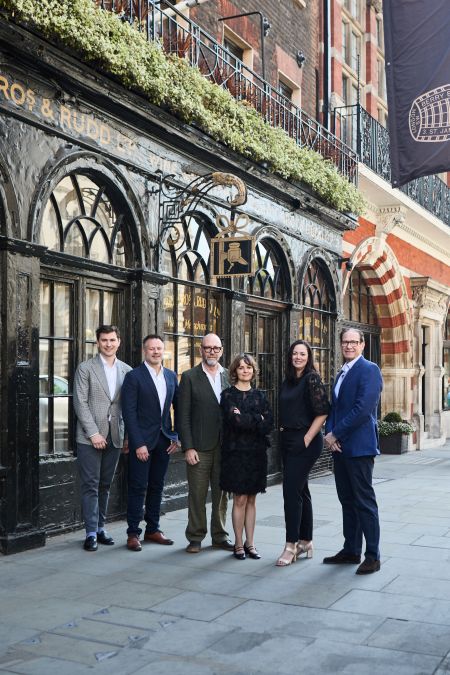
At a masterclass in London at Berry Brothers are, from left, Will Dennison, sales at the UK importer Maisons Marques et Domaines (MMD); Wim Truter, cellar master of Meerlust; Hannes Myburgh, owner of Meerlust; Valeria Maffeis, brand manager of MMD; Deidre Taylor, sales and marketing manager at Meerlust; and Richard Billet, MD of Maisons Marques et Domaines.
Today, there are roughly 2 500 growers and more than 500 cellars producing over a billion litres, of which 865 million litres are sold as wine. Around 40% is exported, and domestic wine sales have tripled. The shift from quantity to quality followed the decline of the KWV’s dominance as buyer of last resort.
Politically, 1975 also marked a turning point. By the early 1970s, government repression had intensified – protests were crushed under the Riotous Assembly Act, and student leaders from Saso and Nusas were banned, a darkly ironic example of “separate but equal”.
......
“Sometimes, we in South Africa forget how much has happened, and in how little time.” – Michael Fridjhon
......
He said that from Meerlust’s first vintage in 1975 until the release of Nelson Mandela, a mere 15 years had elapsed. From that date until today, another 35 years have passed. “Sometimes, we in South Africa forget how much has happened, and in how little time.
“If the political transformation has been extraordinary, the changes that took place in the world of wine were no less remarkable. When Nico Myburgh decided not to sell his grapes and instead to make wine under the Meerlust name, the wine-of-origin legislation had been on the statute books for less than two years. His farm may have belonged to his family for over 220 years, but it had only just become a wine estate.”
Back then, any producer wanting to be taken seriously had to make cabernet sauvignon. Few other varieties existed or were worth planting due to poor quality, virus-infected vines. There was no commercial merlot, cabernet franc, malbec, petit verdot or chardonnay, and almost no shiraz or sauvignon blanc. Even cabernet made up less than 3% of vineyards.
Blended reds were viewed with suspicion – officially, serious producers didn’t make them. Label laws forbade naming the grape varieties in a blend, and with no Bordeaux cultivars available, most assumed that blends contained only inferior or unknown grapes.
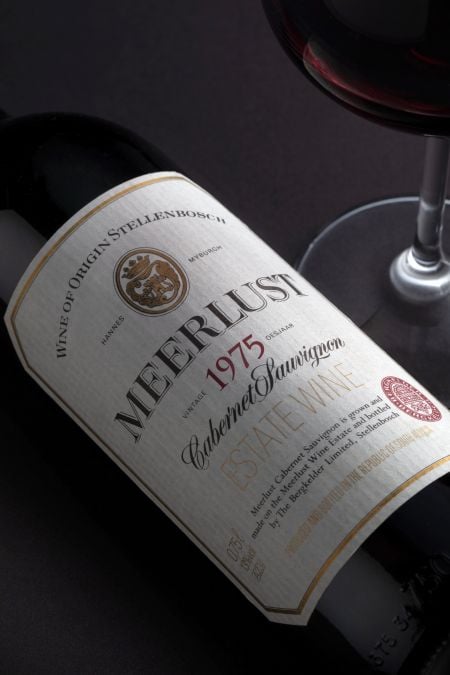
The Meerlust Cabernet Sauvignon 1975, the first wine made under the Meerlust label on this historic farm
“Nico’s cabernet arrived amid much fanfare. In those days, there wasn’t exactly much excitement in the world of Cape wine, so a new wine, from a new (old) estate with an extraordinary pedigree, was very special. I remember the launch of the 1975 Meerlust in 1978. By then, the wine had already won a gold medal at the Stellenbosch regional wine show, as well as being the overall champion young red at the national show.
“It was offered on allocation only – partly because there really wasn’t enough cabernet for South Africa, after the wine-of-origin legislation of 1973 imposed a modicum of truthfulness on wine labelling.”
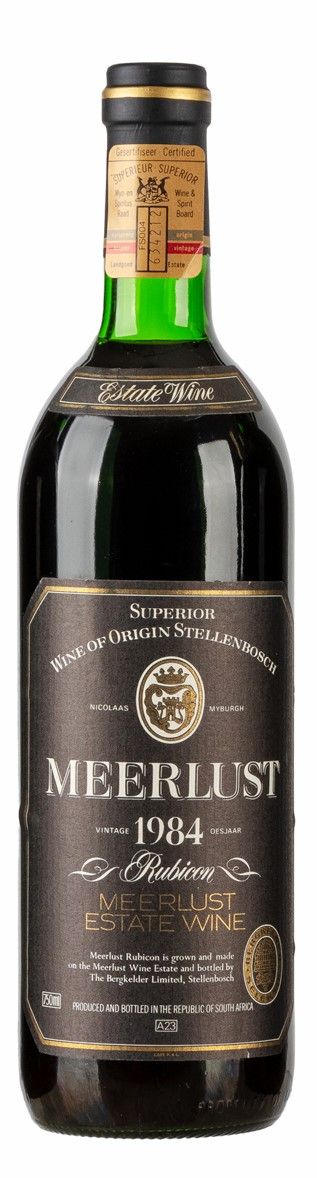
The historic Meerlust Rubicon, which set Meerlust – and the South African wine industry – on a new trajectory
Then came the Rubicon, and by the mid-1980s it was clear that Meerlust was a cabernet-based red wine property, “the first undisputed ultra-premium new arrival on the Cape wine scene in the modern era of the industry”.
Nico and Giorgio were the personalities integrally involved with the image of Meerlust. Hannes joined the farm and spent some time at Chateau Lafite Rothschild with Eric de Rothschild. I don’t think Hannes needed Eric to hone his aesthetic sensibility, but he must have found it liberating to observe the proprietor of a great estate and the custodian of its legacy in action. He discovered that it was both possible and desirable to allow your own personality to express itself despite the burden of past generations. In that sense, I believe that Eric was an important mentor and model for Hannes for when he took over at Meerlust and began making his own decisions about charting its future course.
After Giorgio, Chris Williams modernised the cellar and carried the estate confidently into the new millennium. Since 2019, Wim Truter has continued that evolution with precision and success, proving Meerlust’s strength as both a historic and a forward-thinking estate.
“Inspired by Eric de Rothschild’s revival of Lafite, Hannes has similarly guided Meerlust with quiet vision – honouring its heritage while securing its place among South Africa’s true “first growths”, defined by land, consistency and timeless quality. This is the legacy of the past 50 years, beginning when Nico transformed a mixed farm into a world-class wine estate after visiting Bordeaux in 1967.
“We do more than simply celebrate what has been achieved: we look forward to what is still to come. This first half century is the realisation of what was, when it began, little more than a dream. The decades and centuries which lie ahead will build on this foundation. We cannot even begin to imagine the wines that will be coaxed from the soils and vineyards of Meerlust long after we are dead,” he concluded.
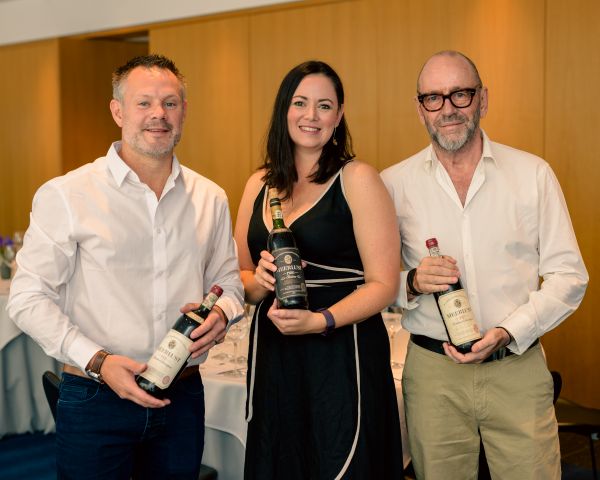
Wim Truter, cellar master; Deidre Taylor, sales and marketing manager; and Hannes Myburgh, owner of Meerlust, at a masterclass lunch in New York at The Modern, Museum of Modern Art
Wim said in his speech that the thoughts expressed by Michael – “the true sage of South African fine wine and renowned internationally” – are both humbling and inspiring.
“We’ve been building on the pioneering work of Hannes’s father, Nico, and Giorgio and on the refinement that others brought after them.
“We’re literally and figuratively continuing to delve further into our terroir. Our site is unique, and we’re in the process of acquiring our own designation, Wine of Origin Eerste Rivier. We’re literally five kilometres from False Bay, and this proximity to the ocean gives us these incredible growing conditions, where we can make very expressive varietal chardonnay and pinot noir, and still ripen Bordeaux varietals perfectly.
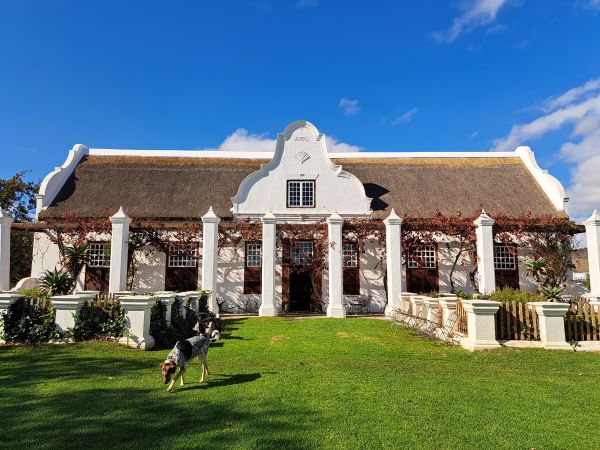
The beautiful Meerlust homestead’s oldest part, dating back to the early 1700s, likely around the time the first owner, Henning Huising, settled there in 1693. The iconic gabled facade was added later, in 1776, during an extension of the house by Johannes Myburgh.
“Diverse soils and carefully matched varieties allow each vintage to express the full character of our estate. Recent investments focused on detailed soil mapping and replanting to optimise vineyard performance and showcase the area’s potential. Continuous training, experimentation and refinement in both vineyard and cellar form the foundation of our progress. Major upgrades to infrastructure and winemaking equipment further strengthen our commitment to excellence.
“At the heart of it all are the dedicated people who craft these wines – from the cellar team to the team in the vineyards and all behind the scenes. We’re proud to say, with optimism, that the best Rubicons are still to come.
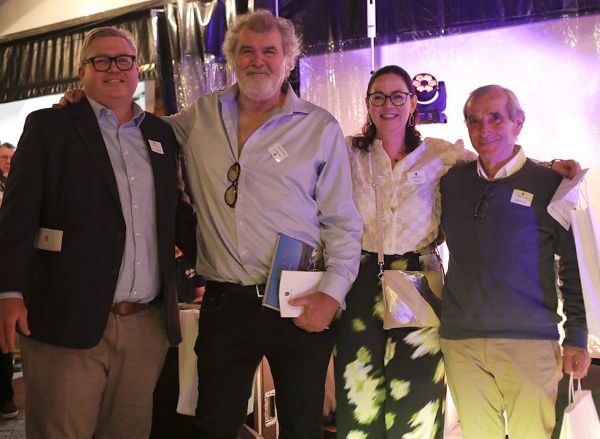
Cheers to a great book! From left: Eugene Ashton, CEO of JB Publishers; Emile Joubert, author of Meerlust: Beyond the Rubicon; Deidre Taylor, sales and marketing manager; and Alain Proust, photographer.
“A brand’s longevity depends on delighting and rewarding our customers, and being supported by loyal trade partners around the world. To all who’ve shared Meerlust wines over five decades – celebrating life, family and freedom – we thank you and invite you to enjoy this milestone with us.”
- The book Meerlust: Beyond the Rubicon (ISBN 99781776194650) is available at R495. Find more information at https://www.meerlust.co.za/.
Also read:
Vier vanjaar Internasionale Chenin-dag met ’n besondere vrou in gedagte
Nuwe baadjie vir Spier Hotel, maar dieselfde goeie beginsels
